ChatGPT vs Gemini: The Ultimate AI Showdown for 2025
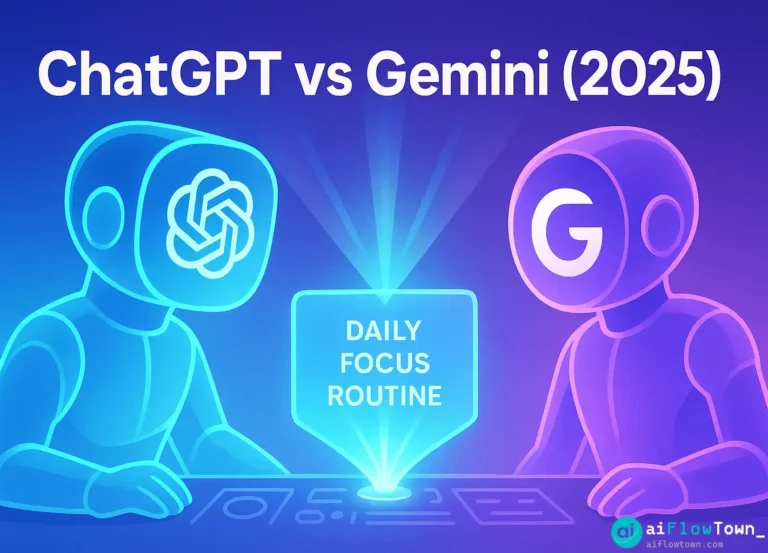
The artificial intelligence landscape is evolving at lightning speed, dominated by two colossal players: OpenAI’s ChatGPT and Google’s Gemini. Both represent the pinnacle of large language model (LLM) technology, capable of generating human-like text, writing code, answering complex questions, and even interacting with images. But as they vie for the title of the “smartest” AI, users are left wondering: which one is truly better? This definitive ChatGPT vs Gemini comparison aims to answer that question.
Making the right choice between these AI titans can significantly impact your workflow, creativity, and productivity. This guide will provide an exhaustive breakdown, moving beyond surface-level observations. We’ll compare their underlying technology, dissect their core features head-to-head, analyze performance differences based on real-world use cases, examine pricing models, and ultimately help you determine which AI powerhouse is the right fit for your specific needs in 2025. Is Gemini better than ChatGPT, or does OpenAI still hold the crown? Let’s dive deep.
Part 1: A Tale of Two Titans – The Origins of ChatGPT and Gemini
Understanding the history and philosophy behind each model provides crucial context for their strengths and weaknesses.
ChatGPT: The Pioneer That Ignited the AI Revolution
Launched by OpenAI in late 2022, ChatGPT burst onto the scene and captured the world’s imagination. Built upon the Generative Pre-trained Transformer (GPT) architecture, its initial free version (powered by GPT-3.5) demonstrated an unprecedented ability to hold natural conversations, generate creative text formats, and perform a wide array of language tasks. Its viral success spurred massive investment and accelerated the AI arms race.
OpenAI quickly followed up with GPT-4, available through the paid ChatGPT Plus subscription. GPT-4 represented a significant leap in reasoning, problem-solving, and multimodal capabilities (initially via plugins, later more integrated). OpenAI’s approach has often been characterized by pushing the boundaries of raw model performance and fostering a large ecosystem through APIs and plugins.
Gemini: Google’s Ambitious Answer
Google, a long-time leader in AI research, responded to ChatGPT’s dominance with Gemini. Announced in late 2023 and rolled out through 2024, Gemini was presented not just as an iteration but as a fundamentally different architecture, designed from the ground up to be multimodal. This means it was trained concurrently on text, images, audio, and video, theoretically allowing for more seamless understanding and reasoning across different types of information.
Gemini comes in different sizes: Pro (the widely available, powerful model comparable to GPT-3.5/4) and Ultra (the flagship, state-of-the-art model designed to compete with or surpass GPT-4). Google’s strategy leverages its vast data resources and deep integration with its existing ecosystem (Search, Workspace, Android) to position Gemini as a more context-aware and up-to-date AI assistant.
Part 2: Core Architecture & Capabilities – Under the Hood
While both are LLMs, their underlying design philosophies differ slightly, influencing their strengths.
- ChatGPT (GPT-4): Exceptionally strong in language understanding, generation, and complex reasoning. Its multimodality, while powerful (especially with GPT-4o), was added iteratively to a primarily text-based foundation. It excels at tasks requiring deep linguistic nuance or creative exploration.
- Gemini (Pro/Ultra): Built natively for multimodality. This potentially gives it an edge in tasks that require simultaneous understanding of text and images (or other modalities). Google also emphasizes its connection to real-time information via Google Search, aiming to provide more current and factual answers compared to models with static knowledge cutoffs.
The key difference lies in origins: ChatGPT evolved from text mastery towards multimodality, while Gemini was conceived as multimodal from day one. This influences how naturally they handle cross-modal tasks.
Part 3: Feature Face-Off – ChatGPT vs Gemini Head-to-Head
Let’s break down how these two AI giants stack up across the most important features. Note that capabilities differ between free and paid tiers (GPT-3.5 vs GPT-4/4o, Gemini Pro vs Gemini Advanced/Ultra).
| Feature/Capability | ChatGPT (Focus on GPT-4/4o) | Gemini (Focus on Pro/Advanced) | Verdict (General Trend) |
|---|---|---|---|
| Text Generation Quality (Creativity, Coherence, Style) | Often considered the gold standard for creative writing, complex instructions, and nuanced tone control. Excels at long-form content generation. | Very strong, often more concise. Tone can sometimes feel slightly more formal or ‘Googley’. Continuously improving. | ChatGPT often edges out Gemini for pure creative writing and complex narrative tasks, but the gap is closing rapidly. |
| Reasoning & Problem Solving (Logic, Math, Planning) | GPT-4 demonstrated significant leaps in complex reasoning. Can handle multi-step problems well. | Gemini Ultra was specifically benchmarked against GPT-4 in reasoning tasks and claims superior performance in many areas. Gemini Pro is also very capable. | Highly competitive. Gemini Ultra potentially leads in specific complex reasoning benchmarks, but GPT-4 remains formidable. Depends on the specific task. |
| Coding Assistance | Excellent code generation, debugging, and explanation capabilities, especially with GPT-4. Large community support. | Strong coding abilities, particularly good at explaining code and integrating with Google Cloud services. | Both are excellent coding assistants. Choice may depend on preferred language or specific integrations. |
| Knowledge & Up-to-dateness | GPT-3.5 has a knowledge cutoff. GPT-4 (with browsing) can access real-time information but sometimes relies on Bing search results. | Natively integrated with Google Search, providing generally more reliable and up-to-date information for current events or rapidly changing topics. | Gemini generally has an advantage for real-time information and factuality due to its direct Search integration. |
| Multimodality (Image Input/Output, etc.) | GPT-4o offers impressive image understanding, analysis, and generation capabilities. Voice interaction is also strong. | Designed natively for multimodality. Strong image understanding, analysis, and generation. Potential for deeper integration with audio/video in the future. | Gemini’s native multimodal architecture may offer a theoretical advantage for complex cross-modal reasoning, but GPT-4o’s practical image capabilities are currently state-of-the-art. Very competitive. |
| Integrations & Ecosystem | Large ecosystem of GPTs (custom chatbots) and plugins (though being phased out/evolved). Strong API for developers. | Deep integration with Google Workspace (Gmail, Docs, Sheets via Duet AI/Gemini for Workspace), Google Search, and Android. Growing extension ecosystem. | ChatGPT has a broader third-party app ecosystem (GPTs). Gemini excels in native integration within the Google universe. |
| User Interface (UI) | Clean, simple, chat-focused interface. Well-established and familiar. | Clean interface, often integrated directly into Google products (Search, Bard/Gemini app). Offers features like draft variations. | Subjective. Both are user-friendly. Gemini’s integration might feel more seamless for heavy Google users. |
| Free Tier Access | Generous access via GPT-3.5. GPT-4o features are also rolling out to free users with limits. | Generous access via Gemini Pro. | Both offer powerful free tiers (ChatGPT 3.5/4o limited vs Gemini Pro). Excellent value from both. |
| Pricing (Paid Tiers) | ChatGPT Plus (~$20/month) offers access to GPT-4/4o, advanced features, higher limits. Team/Enterprise plans available. | Gemini Advanced (~$20/month, often bundled with Google One) offers access to Gemini Ultra, Workspace integration. | Competitively priced at the premium consumer level. Bundling with Google One might add value for Gemini Advanced users. |
Part 4: Performance – Real-World Scenarios
Benchmarks are useful, but how do they perform in day-to-day tasks? Here are some common scenarios and general observations (note: performance changes rapidly with model updates).
- Creative Writing (Short Story): Often, ChatGPT (especially GPT-4) produces more imaginative, flowing, and stylistically consistent prose. Gemini might be more direct or require more specific prompting to achieve a desired creative voice.
- Summarizing a Complex Research Paper: Both can do this well. Gemini might have an edge if the paper requires synthesizing very recent information, due to its Search integration. ChatGPT might be better at capturing subtle nuances in older texts.
- Generating Python Code for Data Analysis: Both are highly capable. Developers often have preferences based on specific libraries or coding styles. ChatGPT’s vast training data might cover more niche libraries, while Gemini might integrate better with Google Colab.
- Analyzing an Image: Both GPT-4o and Gemini demonstrate impressive capabilities in describing images, identifying objects, and even answering questions about visual content. Gemini’s native multimodality might give it an edge in more complex visual reasoning tasks in the future.
- Answering Current Events Questions: Gemini’s direct integration with Google Search typically provides faster, more accurate answers about recent news or developments compared to ChatGPT’s browsing mode, which can sometimes be slower or less direct.
It’s crucial to test both models with prompts relevant to *your* specific workflow. You can find many useful starting points in our AI productivity prompts library.
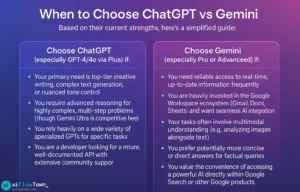
Part 5: Use Cases – When to Choose ChatGPT vs Gemini
Based on their current strengths, here’s a simplified guide:
❇️ Choose ChatGPT (especially GPT-4/4o via Plus) if:
- Your primary need is top-tier creative writing, complex text generation, or nuanced tone control.
- You require advanced reasoning for highly complex, multi-step problems (though Gemini Ultra is competitive here).
- You rely heavily on a wide variety of specialized GPTs for specific tasks.
- You are a developer looking for a mature, well-documented API with extensive community support.
- You prioritize the absolute cutting edge in conversational ability and long-form coherence.
▶️ Choose Gemini (especially Pro or Advanced) if:
- You need reliable access to real-time, up-to-date information frequently.
- You are heavily invested in the Google Workspace ecosystem (Gmail, Docs, Sheets) and want seamless AI integration.
- Your tasks often involve multimodal understanding (e.g., analyzing images alongside text).
- You prefer potentially more concise or direct answers for factual queries.
- You value the convenience of accessing a powerful AI directly within Google Search or other Google products.
Part 6: The “Smarter” AI Myth & The Importance of Prompting
It’s tempting to ask “Which AI is smarter?” but this question is flawed. “Smarts” in AI isn’t a single metric. One model might excel at poetry, the other at calculus. Furthermore, the perceived intelligence often depends more on the user’s prompting skill than the model itself. A well-crafted prompt can elicit brilliant results from a “lesser” model, while a poor prompt can yield garbage from the most advanced one.
Instead of seeking the definitively “smarter” AI, focus on understanding the strengths of each and mastering the art of asking the right questions. Your skill as a prompter is the ultimate determinant of the results you achieve.
Conclusion: An Evolving Landscape, Not a Final Victor
The ChatGPT vs Gemini debate is far from settled, and likely never will be. Both OpenAI and Google are iterating at an incredible pace, constantly leapfrogging each other with new model updates and features. Today’s comparison might be outdated in six months.
The best approach for most users? Utilize both. Leverage the powerful free tiers (ChatGPT vs Gemini free access via GPT-3.5/4o limited and Gemini Pro) to understand their different “personalities” and strengths. If you need premium capabilities, consider subscribing to the one whose strengths best align with your most frequent and critical tasks. ChatGPT Plus (with GPT-4/4o) often wins for creative depth and complex instruction following, while Gemini Advanced (with Ultra and Workspace integration) shines for real-time information and Google ecosystem synergy.
Ultimately, the “smartest” AI is the one that best complements *your* intelligence and workflow. Experiment, learn, and choose the co-pilot that helps you navigate the future of work most effectively.
❓ FAQ
Which AI is better for coding, ChatGPT or Gemini?
Both are excellent coding assistants. GPT-4 has historically been very strong, especially for complex algorithms and debugging. Gemini is also highly capable, particularly with Google Cloud integrations and code explanation. The “better” choice often comes down to personal preference and the specific programming languages or frameworks you use most often. Try both on a typical coding problem you face.
️ Is Gemini better at understanding images than ChatGPT?
Gemini was built with multimodality in mind from the start, potentially giving it an architectural advantage for tasks requiring simultaneous understanding of different data types. However, OpenAI’s latest models like GPT-4o have shown state-of-the-art performance in image analysis and interaction. Currently, both are extremely powerful, and the practical difference for most users might be minimal.
How often do ChatGPT and Gemini get updated?
Both OpenAI and Google are updating their models very frequently, sometimes with minor tweaks happening continuously and major model releases announced every few months to a year. Performance and features can change rapidly, so it’s worth revisiting comparisons periodically.
Is it worth paying for ChatGPT Plus or Gemini Advanced?
If you rely heavily on AI for professional work, paying for the premium tier of either service is often a worthwhile investment. You get access to the most powerful models (GPT-4/4o or Gemini Ultra), higher usage limits, faster response times, and advanced features. Consider which platform’s premium features best align with your daily tasks.
⚠️ Reminder: Even the smartest tools / AI can miss small details or make mistakes. Always double-check your work before presenting or publishing it - a quick review can save hours later.