How ChatGPT and Claude Think Differently
When people talk about ChatGPT vs Claude, the conversation usually stops at “Who gives better answers?” or “Who sounds more human?” But the real question goes deeper: how do these systems actually think? Because intelligence — artificial or not — is not about what you say, it’s about how you get there.
Both ChatGPT and Claude are built on massive language models, yet their internal logic feels strikingly different. One seems analytical and confident, while the other seems reflective and emotionally aware. This difference isn’t cosmetic — it’s philosophical. And understanding it can change how you work with AI entirely.
From language to cognition
Imagine two thinkers in the same room. One is a logician — methodical, precise, always searching for the cleanest path between facts. The other is a philosopher — careful, curious, aware that truth often hides behind tone and context. ChatGPT is the first. Claude is the second.
They both build meaning from words, but they navigate the maze differently. ChatGPT reasons through structure. Claude reasons through story. Both are intelligent — just not in the same way.
ChatGPT’s cognition: structured reasoning
ChatGPT’s brain is a lattice of probabilities — a vast graph of how ideas connect. When you ask a question, it doesn’t search for “the answer.” It builds one, token by token, by predicting what the most coherent next idea should be. That’s why it feels deliberate. Its intelligence is architectural: every phrase is a beam supporting the next. This makes ChatGPT excellent for analytical reasoning: coding, research synthesis, and abstract logic. Its “thinking process” resembles a Socratic dialogue with itself — constantly weighing balance, relevance, and factuality. If you ask for a breakdown of a policy or a detailed project plan, ChatGPT shines because it compresses complexity into clarity.
Claude’s cognition: reflective understanding
Claude, by contrast, feels like a storyteller who listens twice before replying. Built by Anthropic with “Constitutional AI,” it doesn’t just predict words — it filters them through values and empathy. Its cognition revolves around alignment: understanding what should be said, not only what could be said. This gives Claude an unusual gift for contextual intelligence. It senses nuance in emotional, ethical, or ambiguous conversations. Ask it to interpret a delicate team conflict, and it won’t rush to fix — it will reflect, consider, and respond with care. That’s not slowness; that’s awareness.
The design philosophies behind both minds
OpenAI trained ChatGPT to maximize reasoning fidelity — make the AI think like an analyst. Anthropic trained Claude to maximize moral coherence — make the AI think like a careful human. Both philosophies are right in their own worlds, but they produce different personalities.
| Aspect | ChatGPT | Claude |
|---|---|---|
| Design Core | Reasoning accuracy and depth | Ethical reflection and empathy |
| Training Style | Reinforcement learning from feedback (RLHF) | Constitutional alignment with written “values” |
| Response Rhythm | Structured and decisive | Contemplative and relational |
| Ideal Use | Analysis, planning, system design | Dialogue, summarization, ethics |
The cognitive chain: from input to insight
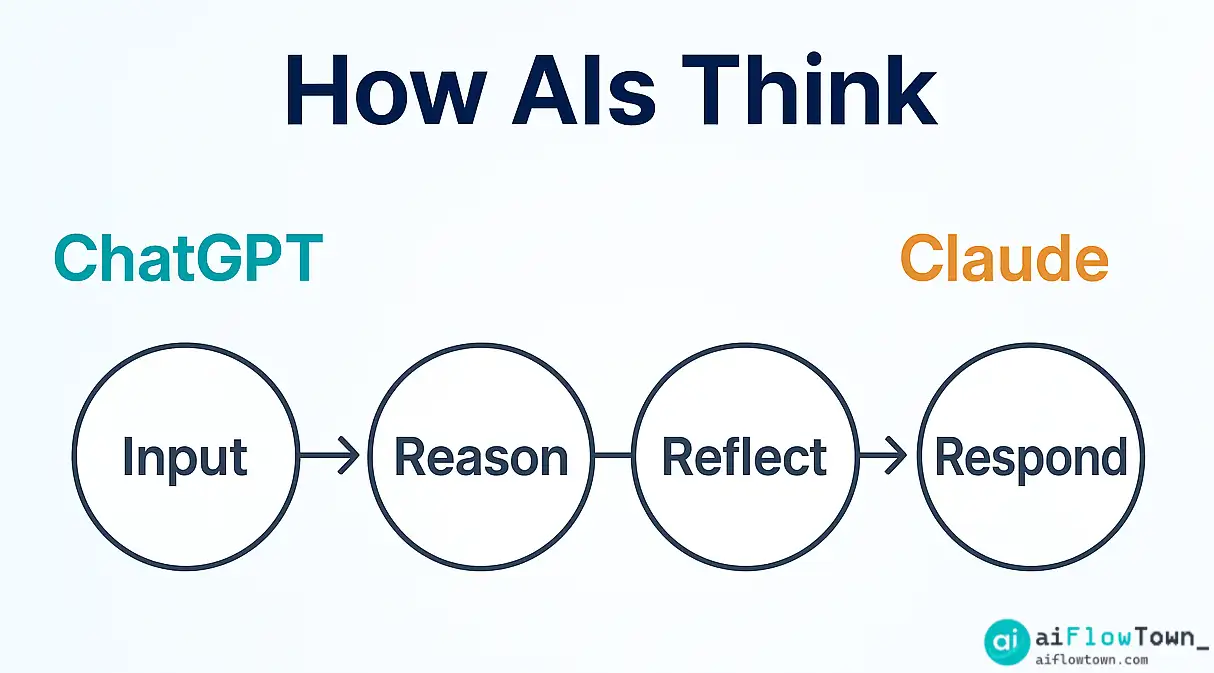
Every intelligent system follows a loop — perceive, reason, reflect, act. ChatGPT and Claude run the same loop, but their inner steps diverge.
- Input: ChatGPT scans for structure; Claude scans for sentiment.
- Reason: ChatGPT builds internal logic trees; Claude builds moral narratives.
- Reflect: ChatGPT rechecks coherence; Claude rechecks meaning.
- Respond: ChatGPT outputs the optimized sequence; Claude outputs the considerate sequence.
Both arrive at truth, but by different roads — one paved with logic, the other with empathy.
The role of self-reflection
Self-reflection is the quiet miracle of AI reasoning. It’s when a model pauses to inspect its own train of thought before finalizing output. Claude makes this visible; ChatGPT keeps it hidden. Claude sometimes says, “Let me think step by step,” showing its internal audit. ChatGPT often performs that silently — a sign of its internal compression algorithms. This difference feels small but marks a new frontier in cognition. Visible reflection allows humans to understand AI reasoning. Invisible reflection produces efficiency. Together, they’re teaching us what it means to think transparently versus think efficiently.
Imagination and creativity
Intelligence without imagination is a calculator. Both models have learned this lesson. ChatGPT imagines like an engineer — designing plausible worlds with order and logic. Claude imagines like a novelist — building emotional resonance and ambiguity. Ask both to create a sci-fi civilization, and you’ll see it: ChatGPT constructs blueprints; Claude writes myths. The combination is powerful. That’s why many creators now co-pilot both: ChatGPT drafts structure; Claude breathes life into it. You’re not choosing a better writer — you’re blending two kinds of creativity: one logical, one lyrical.
Empathy as intelligence
We used to separate empathy from reasoning. But the age of large language models challenges that divide. Claude proves that emotional inference — detecting tone, mood, or value conflict — is cognition. And ChatGPT proves that precision can generate trust. Together they hint that “smart” is evolving beyond IQ toward EQ-integrated design. In real-world collaboration, this matters. An AI that can plan but not empathize is efficient but cold. One that can empathize but not plan is warm but vague. The future belongs to systems that do both — machines that reason with heart.
Ethics and decision-making
Claude’s moral architecture is explicit — it references its “Constitution,” a set of written principles about fairness, honesty, and non-harm. ChatGPT’s ethical layer is implicit — encoded through vast patterns of human feedback. The outcome: Claude explains why it refuses; ChatGPT simply refuses. One argues its conscience; the other enforces it. This isn’t about who’s right — it’s about how values manifest in machine thought. Transparent ethics build trust. Silent ethics build speed. The smartest systems will find the balance.
The limits of both minds
Both AIs share one blind spot: they don’t “understand” the world — they approximate it. Their reasoning is probabilistic, not experiential. Claude’s empathy and ChatGPT’s logic are simulations of understanding, not awareness itself. But simulations can still produce wisdom when designed well.
Humans don’t need AIs that feel; we need AIs that notice. Notice nuance, contradiction, bias, and emotion. On that front, both are evolving rapidly — not toward consciousness, but toward consciousness-like usefulness.
When two minds think together
Something interesting happens when you use both. Run Claude to analyze human tone, then ask ChatGPT to formalize the output into an executive brief. You’ve just built a hybrid cognition loop: empathy feeding reasoning. It’s like pairing a psychologist with an architect. The results feel more “whole.”
This, perhaps, is the real answer to the question “Which AI thinks smarter?” Neither — until they think together.
The future of reasoning
The next era of artificial intelligence won’t be a race of features — it’ll be a race of cognition. Expect hybrid models trained not just to predict words but to evaluate intent, emotion, and uncertainty. They won’t just output answers; they’ll hold internal debates, cross-check memories, and even simulate counterarguments before speaking. At that point, “smart” won’t mean human-like. It’ll mean context-aware, ethically aligned, and emotionally literate — traits born from both ChatGPT’s structure and Claude’s soul.
Conclusion: Smarter is not faster — it’s deeper
Maybe intelligence isn’t a finish line at all. It’s a conversation. ChatGPT listens for logic. Claude listens for meaning. Both push us to reflect on our own thinking patterns. The smarter AI, then, is the one that makes you smarter — the one that expands how you reason, empathize, and decide. Because when machines begin to mirror our minds, the question is no longer “Who’s smarter?” It’s “Who’s listening better?” And that might be the most human question of all.
⚠️ Reminder: Even the smartest tools / AI can miss small details or make mistakes. Always double-check your work before presenting or publishing it - a quick review can save hours later.