Why Customer Email Tone Is So Hard
When someone’s angry at you—even if it’s about a product or service, not you personally—your brain goes into defense mode. You want to correct their misunderstandings, explain the situation, maybe push back on unfair accusations. These impulses make sense emotionally but destroy customer relationships professionally.
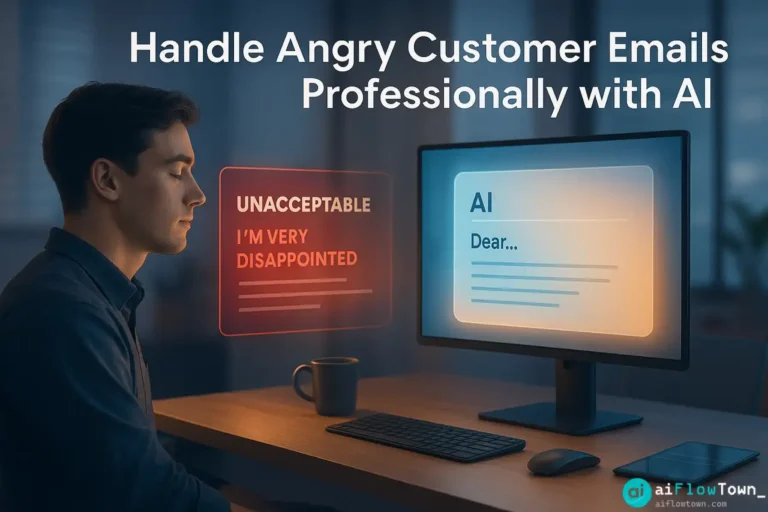
The challenge of using ai for customer emails isn’t just about grammar—it’s about finding the tone that validates the customer’s feelings while steering toward resolution. That’s hard when you’re stressed, defensive, or dealing with your tenth angry email of the day. AI provides emotional distance and structural consistency that humans struggle to maintain under pressure.
Good customer service responses follow a pattern: acknowledge → empathize → take ownership → explain → solve → prevent. Hitting all these elements while staying calm and professional is where AI helps automatically.
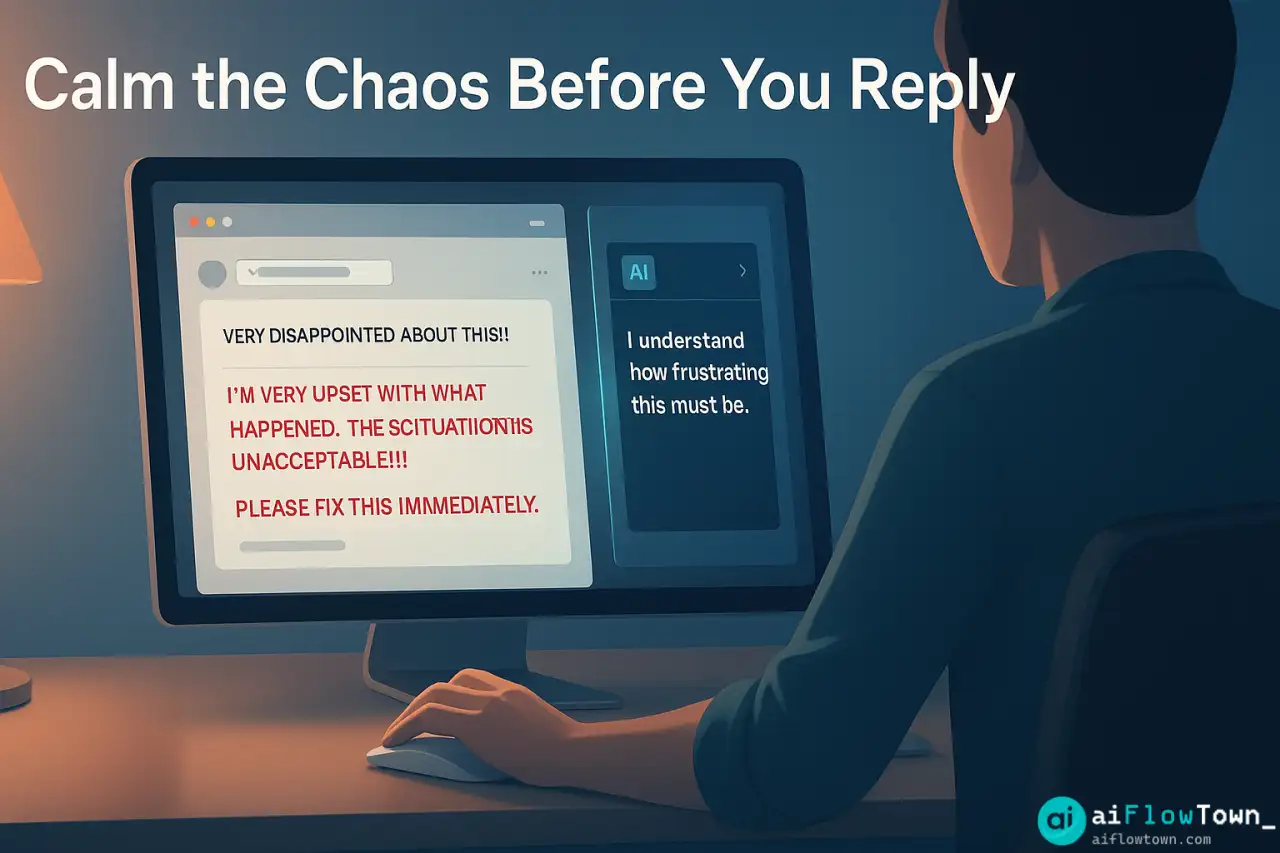
The Empathy-First Framework
Why Empathy Comes Before Everything
Angry customers don’t want explanations first. They want to feel heard. If your first sentence is “Actually, our policy states…,” you’ve already lost them. Start with acknowledgment of their experience, then move to solutions.
| Customer’s Emotion | What NOT to Say | What to Say Instead |
|---|---|---|
| Frustrated | This is standard procedure | I understand this has been frustrating |
| Disappointed | It works fine for everyone else | I’m sorry this didn’t meet your expectations |
| Angry | You misunderstood how it works | I can see why this is upsetting |
| Confused | It’s clearly stated in the manual | Let me help clarify this |
The empathy-first approach using ai prompts to handle angry customer emails professionally de-escalates before solving. For more communication strategies, visit AI productivity prompts.
The Core Response Prompt
Here’s the prompt template that transforms angry customer emails into professional, empathetic responses:
Help me respond to this upset customer email professionally.

Their email
[Paste the angry customer email]

The situation
[Brief factual summary of what happened]

What we can/can't do
- Can do [List realistic solutions]
- Can't do [List limitations, if any]

Write a response that
1. Acknowledges their frustration specifically
2. Takes appropriate ownership (apologize for what's genuinely our fault)
3. Explains briefly what happened (without making excuses)
4. Offers concrete solution or next steps
5. Includes a gesture of goodwill if appropriate
6. Ends with commitment to prevent recurrence

Tone requirements
- Empathetic but professional
- Apologetic where warranted, not over-apologizing
- Solution-focused
- No corporate jargon or empty phrases
- Natural, like a helpful human wrote it

Length: 150-200 words max — clear and complete, not verbose.
This structure ensures you cover all necessary elements using respond to upset customers with ai help systematically. Learn more at AI workflow examples.
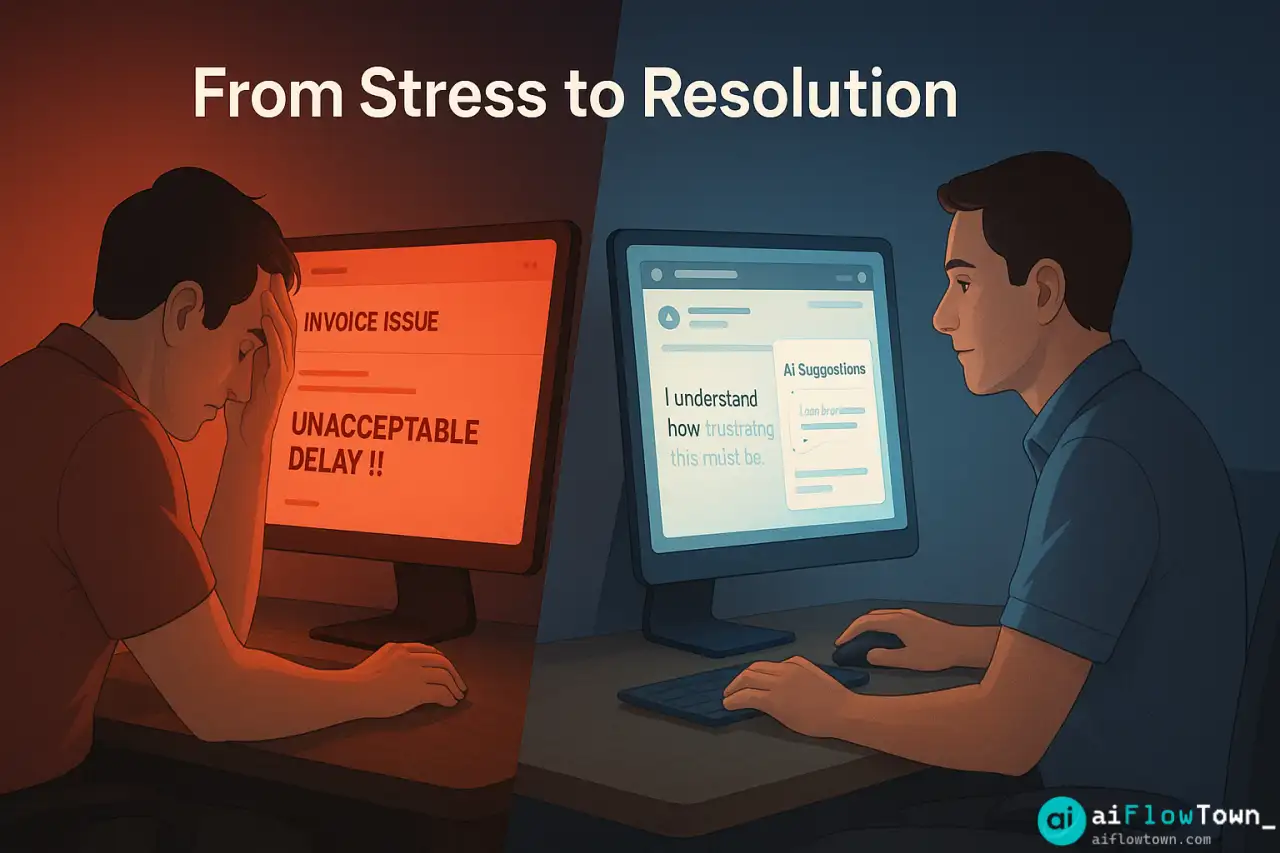
Example Scenarios and Responses
Scenario 1: Shipping Delay
Customer’s angry email
I ordered this TWO WEEKS AGO for my daughter’s birthday which is TOMORROW and you’re telling me it’s still “in transit”? This is absolutely unacceptable. I specifically paid for express shipping. You’ve ruined her birthday and I want a full refund immediately.
AI-crafted response
I’m sincerely sorry your order hasn’t arrived in time for your daughter’s birthday—I can only imagine how disappointing and frustrating this is.
You’re absolutely right that express shipping should have delivered by now. I’ve looked into your order and it’s currently with the carrier. I’m escalating this to our shipping team immediately to determine what went wrong.
Here’s what I’m doing right now
– Processing a full refund for shipping costs (you’ll see this within 24 hours)
– Sending you a [discount code] toward a future order
– Following up with the carrier to expedite deliveryI’ll update you by end of day with tracking details and expected delivery. This isn’t the experience we want to provide, and I apologize for letting you down on such an important occasion.
[Name]
– Empathetic Resolution –
This response acknowledges feelings, takes ownership, explains action, offers compensation, and commits to follow-up using de-escalate customer complaints using chatgpt principles.
Scenario 2: Product Not Working
Customer’s email
Your product is garbage. I’ve tried everything and it STILL doesn’t work. I followed all the instructions. This is the worst purchase I’ve ever made. I want my money back and I’m leaving a 1-star review.
AI-crafted response
I’m really sorry you’re having this experience—when something doesn’t work as expected, it’s incredibly frustrating, especially when you’ve followed all the troubleshooting steps.
Let me help you get this resolved. I’d like to either:
1. Walk you through a couple of additional troubleshooting steps that solve this specific issue 90% of the time
2. Replace your unit immediately at no cost
3. Process a full refund if you’d preferWhich would work best for you? If you’re willing to try troubleshooting, I can jump on a quick call right now, or send you a video showing the exact steps.
We definitely want to make this right. You shouldn’t have to fight with a product that’s supposed to make your life easier.
[Name]
– Solution-Focused Response –
Empathy first, then multiple clear options. Customer feels heard and has control over the resolution path using write empathetic support emails with ai approach.
The Response Checklist
Before sending any response to an angry customer, verify it includes:
- ✅ Acknowledgment — You specifically reference their frustration/situation
- ✅ Apology — You apologize for what’s genuinely your company’s responsibility
- ✅ Explanation — Brief context without excuse-making or blame-shifting
- ✅ Solution — Concrete next steps or options, not vague promises
- ✅ Goodwill — Refund, discount, upgrade—something tangible when appropriate
- ✅ Prevention — What you’re doing to prevent this happening again
- ✅ Timeline — When they can expect resolution or follow-up
If your response misses any of these, AI can help you add them. This is essential for manage difficult customer communication with ai prompts. For more strategies, check productivity flow hacks.
Tone Control: Matching the Situation
For Justified Anger
When you genuinely dropped the ball, be direct about it.
Add to your prompt
This is our fault—we made a clear error. Be direct in acknowledging this. Don't minimize or deflect. Customer's anger is completely justified. Apologize sincerely and own the mistake fully.For Misunderstanding
When the customer misunderstood something, clarify without condescension.
Add to your prompt
Customer has a misunderstanding about how this works. Clarify gently without making them feel stupid. Frame it as "Let me explain how this works" not "You misunderstood." Educate while maintaining their dignity.For Unreasonable Demands
When the customer wants something impossible, set boundaries kindly.
Add to your prompt
Customer is asking for something we genuinely can't provide. Explain limitations empathetically while offering alternatives. Maintain firm boundaries without being dismissive. Show you want to help within what's possible.Building Long-Term Trust
Pattern Recognition
If you handle customer emails regularly, save your best AI-generated responses. Over time, you’ll notice patterns: certain phrasing works better for certain situations. Build a library of proven responses you can adapt.
Consistency Across Team
If multiple people handle customer service, share the AI prompts. This ensures everyone responds with similar empathy and professionalism, maintaining consistent brand voice regardless of who answers.
Learning from Responses
After sending an AI-assisted response, note how the customer reacted. If they escalated further, what was missing? If they thanked you and the issue resolved smoothly, what worked? Refine your prompts based on real outcomes.
❓ FAQ
Will customers know I used AI?
Not if you review and personalize the output. AI provides structure and tone—you add specific details only you know. The result reads as professional human communication, which it is: human-guided, AI-assisted.
⚡ What about responses that need immediate action?
Use AI for the email response, take action immediately. Tell the customer “I’m [doing X right now] and will update you within [timeframe].” Then actually do it. AI helps you communicate well, but you still need to deliver on promises.
Should I always offer compensation?
Not always, but when you’ve genuinely failed the customer, yes. AI can suggest appropriate compensation based on the situation. Small issues: discount on next purchase. Major issues: full refund plus extra. Match the remedy to problem severity.
What if email isn’t resolving the issue?
Offer to call: “I’d like to discuss this directly to make sure we fully resolve it. Could I call you at [time]?” Some situations need real-time conversation. Use AI for the email offering the call, then handle the call personally.
What about customers who stay angry after a good response?
Some people need to vent. Your response being professional and empathetic is what matters—you can’t control their reaction. Document that you made reasonable attempts to resolve. Sometimes the relationship isn’t salvageable, and that’s okay.
Final Thoughts
Angry customer emails trigger emotional reactions that lead to poor responses. Using ai for customer emails isn’t about being fake or robotic—it’s about accessing your most professional, empathetic self when stress makes that hard to do naturally.
The AI prompts provide structure, tone, and consistency. You provide the specific details, judgment about what to offer, and final review for authenticity. Together, you create responses that de-escalate, solve problems, and sometimes even turn angry customers into loyal advocates.
Next time you open an all-caps email full of exclamation marks, don’t panic-draft three versions you hate. Use AI to structure your response. You’ll send something you’re proud of instead of something you regret.
⚠️ Reminder: Even the smartest tools / AI can miss small details or make mistakes. Always double-check your work before presenting or publishing it - a quick review can save hours later.