Do Smarter Literature Reviews with AI Guidance
The literature review: a mountain of PDFs, a blurry screen, and the sinking feeling you’re missing something big. Every researcher knows this struggle. You’re not just reading; you’re hunting for themes, weaknesses, and a tiny, unpaved path where your own research can live. It’s exhausting. AI won’t write your paper for you (and it shouldn’t), but it can be a tireless research assistant. The difference between drowning in data and finding clarity isn’t the AI itself—it’s having the right literature review prompts to guide it.
What AI Actually Does for a Literature Review
Let’s be clear. You can’t just ask an AI to “write a literature review.” This is a recipe for hallucinations, plagiarism, and a bad grade. The real power of AI is in speeding up the manual labor of research, not replacing the thinking.
Instead of spending 40 hours reading, you can spend 10 hours prompting and 30 hours thinking, synthesizing, and writing. AI helps you:
- Summarize papers in seconds, not hours.
- Extract key data like methodologies and sample sizes.
- Compare arguments from multiple papers at once.
- Identify themes you might have missed.
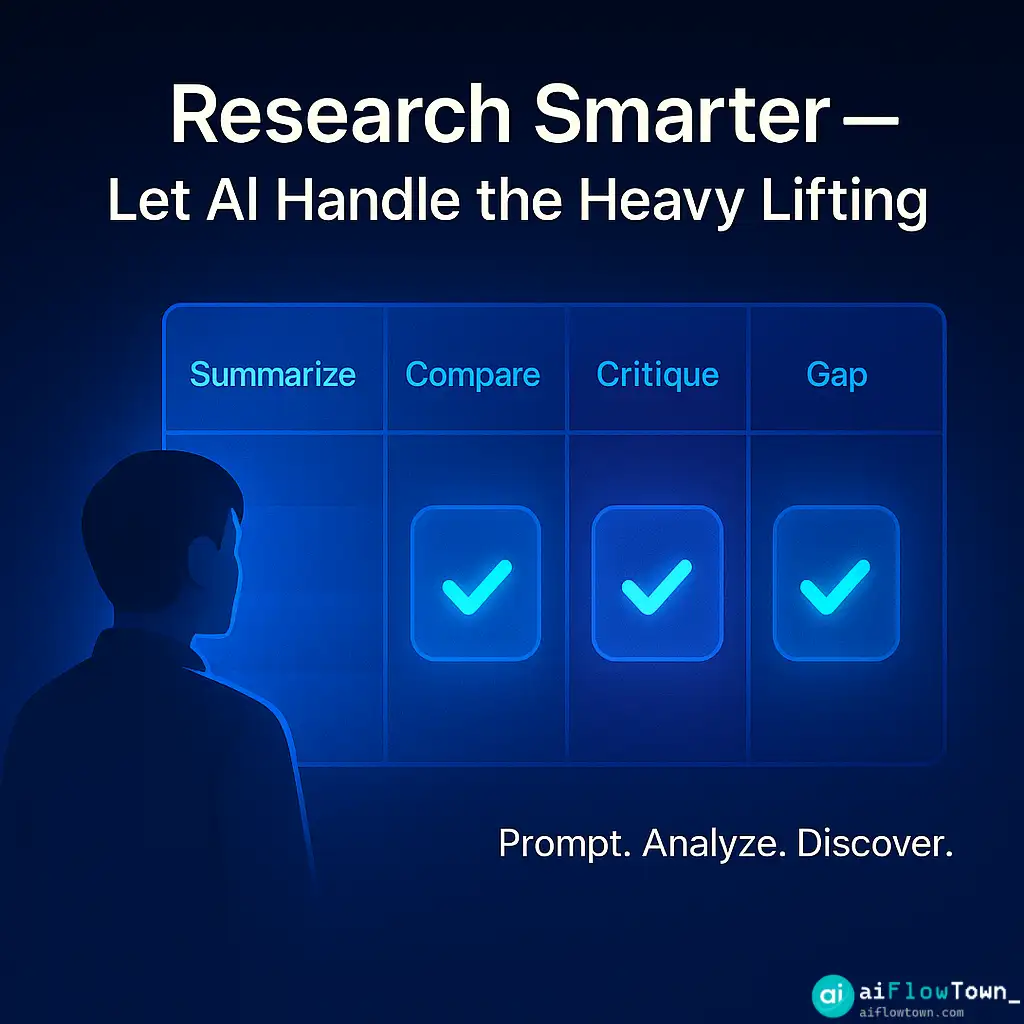
- Spot research gaps by highlighting what isn’t being said.
This is a core part of building smarter AI workflows for academic and professional work.
Types of Literature Review Prompts
Good prompts fall into specific categories. Here’s a simple breakdown of the main types and what they do for you.
| Prompt Category | Primary Goal |
|---|---|
| Summarization & Extraction | Get the core ideas of one paper, fast. |
| Synthesis & Theming | Find connections and themes between multiple papers. |
| Critique & Gap-Finding | Analyze weaknesses and find new research opportunities. |
| Methodology Analysis | Understand how the research was done. |
20 Core AI Prompts for Your Next Lit Review
Here are 20 prompts you can copy, paste, and adapt. Always provide the full text of the paper (or papers) to the AI first, then use the prompt.
1. Summarization & Extraction Prompts
Use these to speed-read a single paper.
**1. The Main Argument:**
"Analyze the provided text. What is the single main argument or thesis of this paper?"

**2. Key Findings:**
"Extract the top 5 key findings or results from this study."

**3. The 'Abstract+' Prompt:**
"Summarize this paper in 300 words, focusing on:
1.  The specific research question.
2.  The methodology used.
3.  The main conclusions."

**4. Methodology Extractor:**
"Describe the research methodology used in this paper. What was the sample size? What were the data collection methods?"

**5. Definition Finder:**
"Find and define the key theoretical terms used by the author in this text."
2. Synthesis & Theming Prompts
Use these after you’ve fed the AI 2-5 different papers.
**6. Compare & Contrast:**
"Based on Paper 1 and Paper 2, compare and contrast their main arguments regarding [Your Topic]."

**7. Find Main Themes:**
"I've provided 5 research papers. What are the 3-4 major recurring themes or debates among them?"

**8. Identify the 'Conversation':**
"How does Paper 3 build upon or challenge the findings in Paper 1 and Paper 2?"

**9. Timeline of Ideas:**
"Organize the provided papers chronologically and explain the evolution of [Your Topic] from the earliest paper to the latest."

**10. Synthesis Table:**
"Create a table summarizing these 3 papers. Columns should be: Author, Main Argument, Methodology, and Key Finding."
3. Critique & Gap-Finding Prompts
This is where you find your research opportunity.
**11. Find Limitations:**
"Analyze the 'Limitations' section of this paper. What weaknesses did the author(s) identify?"

**12. Find 'Future Research':**
"Extract all suggestions for 'future research' or 'next steps' mentioned in this paper."

**13. Identify Research Gaps:**
"After analyzing all [Number] provided papers, what research gaps or unanswered questions remain on [Your Topic]?"

**14. Critique the Argument:**
"What are the potential weaknesses or unexamined assumptions in this paper's argument?"

**15. Uncover Dissonance:**
"Where do these papers disagree? Identify the main points of conflict or debate in the literature."
4. Structuring & Writing Prompts
Use these to organize your own thoughts.
**16. Outline Builder:**
"Based on the themes identified, create a logical outline for a literature review section titled '[Your Section Title]'."

**17. Find Supporting Quotes:**
"Find 3-5 direct quotes from the provided text that best support the argument that [Your Argument]."

**18. Paraphrasing Tool:**
"Take this sentence: '[Quote]'. Paraphrase it for a formal academic paper and provide a citation template."

**19. 'So What?' Prompt:**
"Based on my summary of the literature, what is the 'so what?' Why does this research matter?"

**20. Problem Statement Draft:**
"Draft a problem statement that starts by summarizing the 'known' (from the provided papers) and then identifies the 'gap' (the unanswered question)."
Using these templates is a smart way to build your skills. For more ideas, you can check out our other AI productivity prompts.
How to Use These Prompts (and What to Avoid)
A prompt is only as good as the person using it. Follow these rules to get real results and avoid academic trouble.
Warning: Do Not Plagiarize
Never copy-paste AI-generated text directly into your paper. AI is for summarizing, synthesizing, and finding gaps. It is not the author. Use it to understand the material, then write your own analysis in your own voice. Always double-check AI summaries against the original text.
Insight: Be Specific and Provide Context
Don’t just paste 20 papers and ask, “Find gaps.” You’ll get generic answers. It’s better to feed the AI 3-5 papers that are closely related and ask a specific question, like: “Analyze these 3 papers on [Specific Topic]. What methodologies do they all use, and what is a potential alternative methodology they overlook?”
Many of the best free AI tools are powerful enough to run these prompts, so you can start this process without spending any money.
❓ FAQ
Is it plagiarism to use AI for a literature review?
It is plagiarism if you copy-paste the AI’s words and claim them as your own. It is not plagiarism to use AI as a tool to summarize, find themes, or identify gaps in papers that you have read and are citing properly. Think of it as a search engine, not an author.
How many papers can I give an AI at once?
This depends on the AI’s “context window.” For most free tools, pasting 1-2 full papers is the limit. For paid tools (like Claude 3 or GPT-4o), you can often upload 5, 10, or even more PDFs at once. For best results, start small with 2-3 papers that are closely related.
What’s the best AI tool for research?
There isn’t one “best” tool. General tools like ChatGPT and Claude are excellent for text analysis. Specialized tools like Elicit and ResearchRabbit are designed specifically for academic paper discovery and analysis. A good strategy is to use a specialized tool to find papers and a general tool to analyze the text.
Final Thoughts
A literature review is a hunt for knowledge, and AI is the best mapmaker we’ve ever had. It helps you see the terrain, find the well-worn paths, and spot the blank spaces on the map where you can build.
By using smart literature review prompts, you shift your work from manual data entry to high-level strategic thinking. You spend less time reading and more time understanding. That’s how you do faster, more accurate research without compromising quality.
Want more copy-and-paste prompts to speed up your work? Check out our ultimate AI prompt library for templates on writing, marketing, and more.
⚠️ Reminder: Even the smartest tools / AI can miss small details or make mistakes. Always double-check your work before presenting or publishing it - a quick review can save hours later.