
Focus in the Age of AI Overload
We’re living in a paradox. Artificial intelligence, the most powerful productivity tool ever created, promises to automate the mundane, clear our schedules, and free us up for the deep, meaningful work we’ve always wanted to do. Yet, many of us find ourselves more distracted, more fragmented, and less capable of deep thought than ever before. This struggle to maintain distraction focus is the core challenge of the modern knowledge worker.
We have an AI that can write a draft in seconds, but we spend an hour tweaking the prompt. We have a tool that can summarize a report instantly, but we get lost in the endless possibilities it presents. The very tool designed to boost our AI productivity can become our primary source of distraction. The future of work won’t be defined by who can use AI, but by who can master their attention in a world saturated with it.
This guide isn’t about simply blocking notifications or trying harder. It’s about understanding the new psychology of AI-driven distraction and rewiring your relationship with technology. We’ll explore the cognitive traps these tools create and provide actionable systems to help you reclaim your focus and thrive in this new era.
Part 1: The New Distraction: Understanding AI-Induced ‘Cognitive Grazing’
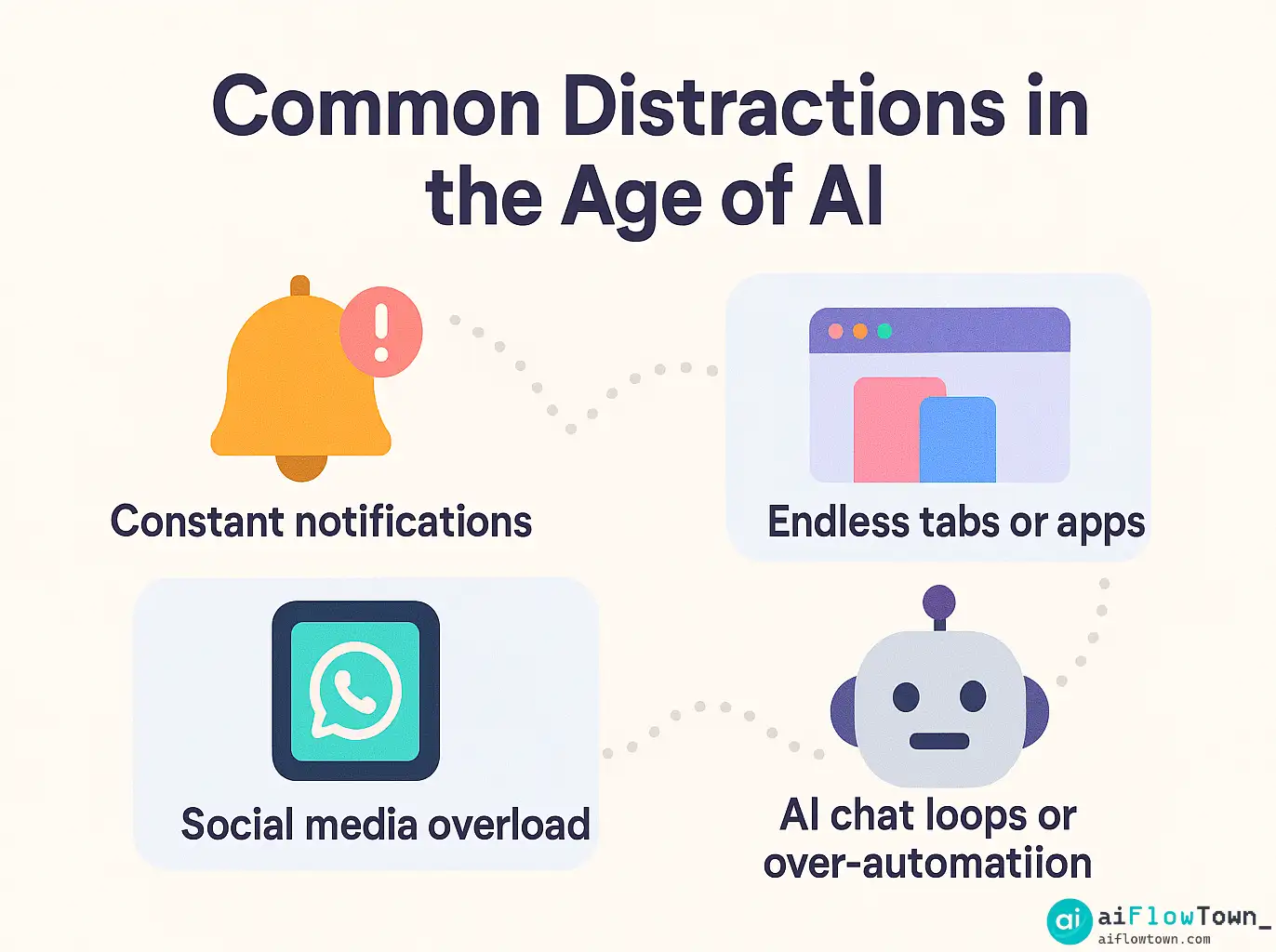
Traditional distractions are external and obvious: a phone call, a notification, a colleague tapping on your shoulder. AI, however, introduces a more insidious, internal form of distraction. We call it “cognitive grazing”. Cognitive grazing is the act of rapidly jumping between a multitude of AI-generated ideas, options, and content pieces without ever settling on one to develop deeply. Because AI can generate content, ideas, and solutions so quickly and with such little effort, it triggers a dopamine response in our brains.
Each new output feels like a small win, a spark of progress. This encourages a shallow, rapid-fire mode of thinking. Instead of deeply pondering a single problem for twenty minutes, we graze across a dozen AI-generated options in five. This creates what psychologists call cognitive distraction—a state where your attention is so fragmented that you are unable to engage in the rigorous, sustained mental effort required for true breakthroughs.
The constant context-switching exhausts our finite supply of directed attention, leaving us feeling busy but unproductive. The danger is that we start to mistake the activity of using AI for the accomplishment of valuable work. The real work isn’t generating the draft; it’s the critical thinking, strategic editing, and creative synthesis that follows. And for that, you need focus.
Part 2: The Mindset Shift: From Autopilot to Pilot
As AI automates more routine tasks—the writing of basic emails, the summarization of documents, the creation of first drafts—our core value proposition as knowledge workers fundamentally shifts. We are no longer the engine of the car, responsible for the raw horsepower of production. We are the pilot, responsible for providing direction, making strategic decisions, and handling the complex, nuanced problems the AI cannot. It’s a shift from production value to judgment value.
Embracing this pilot mindset means accepting that your most valuable asset is no longer the speed at which you can type or summarize, but the quality and depth of your focused attention. It means viewing your ability to concentrate as a precious resource to be managed and protected with the same seriousness you would apply to a budget or a project timeline. The strategies below are designed to help you protect and strengthen that asset, ensuring you remain in control of your cognitive cockpit.
Part 3: Seven Strategies for Deep Focus in the AI Era
Reclaiming your focus isn’t about willpower alone; it’s about building systems and habits that make concentration the path of least resistance. These strategies are designed to create a clear structure for your human-AI collaboration.
1. Batch Your AI Interactions in “Sprints”
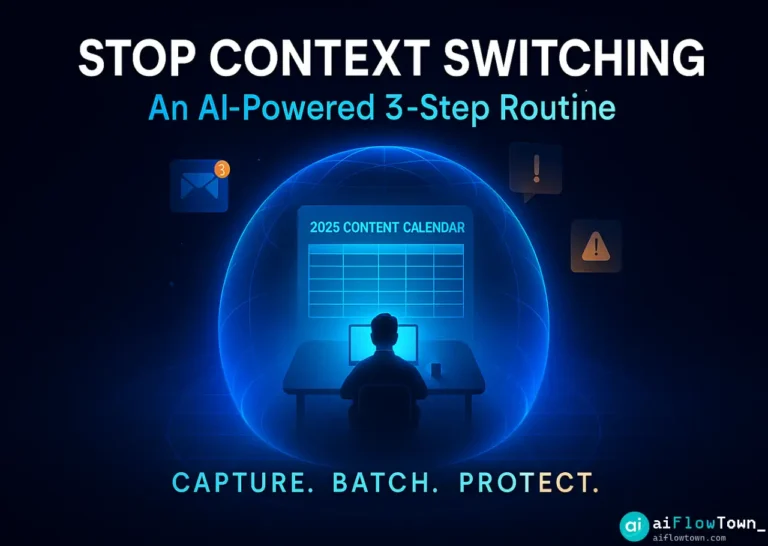
Instead of having AI tools open all day as a constant companion, treat them like a highly specialized consultant you’ve booked for a specific time. Schedule short, intense “AI Sprints” in your calendar with a single, clear objective. This method of “timeboxing” is incredibly effective.
- Before: An AI chat window is open all day. You ask it a question, get distracted by the answer, ask another, and your “deep work” block becomes a series of shallow interactions.
- After: From 9:00 AM to 9:30 AM is your “Research Sprint.” You use AI to gather data, summarize articles, and brainstorm ideas. At 9:30 AM, you close all AI tabs. The rest of your morning is a “Deep Work” block where you synthesize that research without interruption.
This “batching” method prevents the constant context-switching that kills productivity and allows you to transition into a state of deep work with AI‘s support, rather than its interference.
2. Define a Clear “Job to Be Done” Before You Prompt
Never open an AI tool without a specific, written-down question or goal. Aimless exploration is a recipe for distraction and a gateway to cognitive grazing. Before you type a single word, physically write down on a notepad or a sticky note: “What is the one, single output I need from this interaction?”
- Weak Goal: “See what AI says about marketing.” (This is an invitation for a two-hour rabbit hole).
- Strong Goal: “Generate a list of 5 blog post titles about content marketing for a B2B SaaS audience, focused on the pain point of lead generation.” (This is a specific job with a clear deliverable).
This simple habit turns the AI from a time-wasting novelty into a purpose-driven tool.
3. Physically Separate Generation and Creation Phases
Treat the output from an AI as raw material, not a final product. The act of generating text is not the same as the act of creating value. To enforce this, create a physical or digital separation in your workflow.
- Generation Phase (with AI): Use AI to create a rough draft, outline, or collection of ideas in one application (e.g., the web browser). This phase is about quantity and speed.
- Creation Phase (without AI): Copy the raw material from the AI and paste it into a different, “distraction-free” application (e.g., a clean text editor or a new document). Then, close the AI tool completely. Now, your deep focus begins. This is where you edit, rewrite, add your unique insights, and shape the raw material into something valuable.
This separation reinforces that the AI is an assistant, not the author. Your brain is the creator.
4. Practice Intentional “Analog Hours”
The constant availability of AI can atrophy our natural problem-solving and creative muscles. To counteract this, schedule regular, intentional periods of “tech-free” thinking. This could be a 30-minute walk without your phone where you ponder a problem, or a 1-hour brainstorming session with only a whiteboard or a notebook. This practice of mindful technology use is crucial.
By forcing yourself to solve problems without the AI crutch, you build your capacity for independent thought and make your time with AI more purposeful and efficient when you do use it. You’ll approach the AI with better questions because you’ve already done the hard thinking yourself. This is a core part of building your own personal operating system for thinking.
5. Optimize Your Environment for Single-Tasking
Your environment dictates your focus. When it’s time for deep work, be ruthless about eliminating potential distractions. This isn’t just about silencing your phone; it’s about creating a digital “focus sanctuary.”
- Use a separate browser profile for focused work, with no social media or distracting bookmarks logged in.
- Use full-screen modes for your applications (like writing or coding) to hide unnecessary menus, docks, and tabs.
- Consider using a website and app blocker like Freedom to make distraction impossible during your designated deep work blocks.
By making focus the easiest option, you conserve the willpower needed for the actual work.
6. Set “Good Enough” Thresholds for AI Output
The quest for the “perfect prompt” can be a form of productive procrastination. You can spend an hour refining a prompt to get a 95% perfect output, when a 2-minute prompt could have given you an 80% good output that you could then fix yourself in 15 minutes. Set a rule: spend no more than 5-10 minutes on prompting for any given task. Get a “good enough” output, and then shift your energy to the human-centric work of refining and improving it.
7. Use AI to Build Your Focus Systems
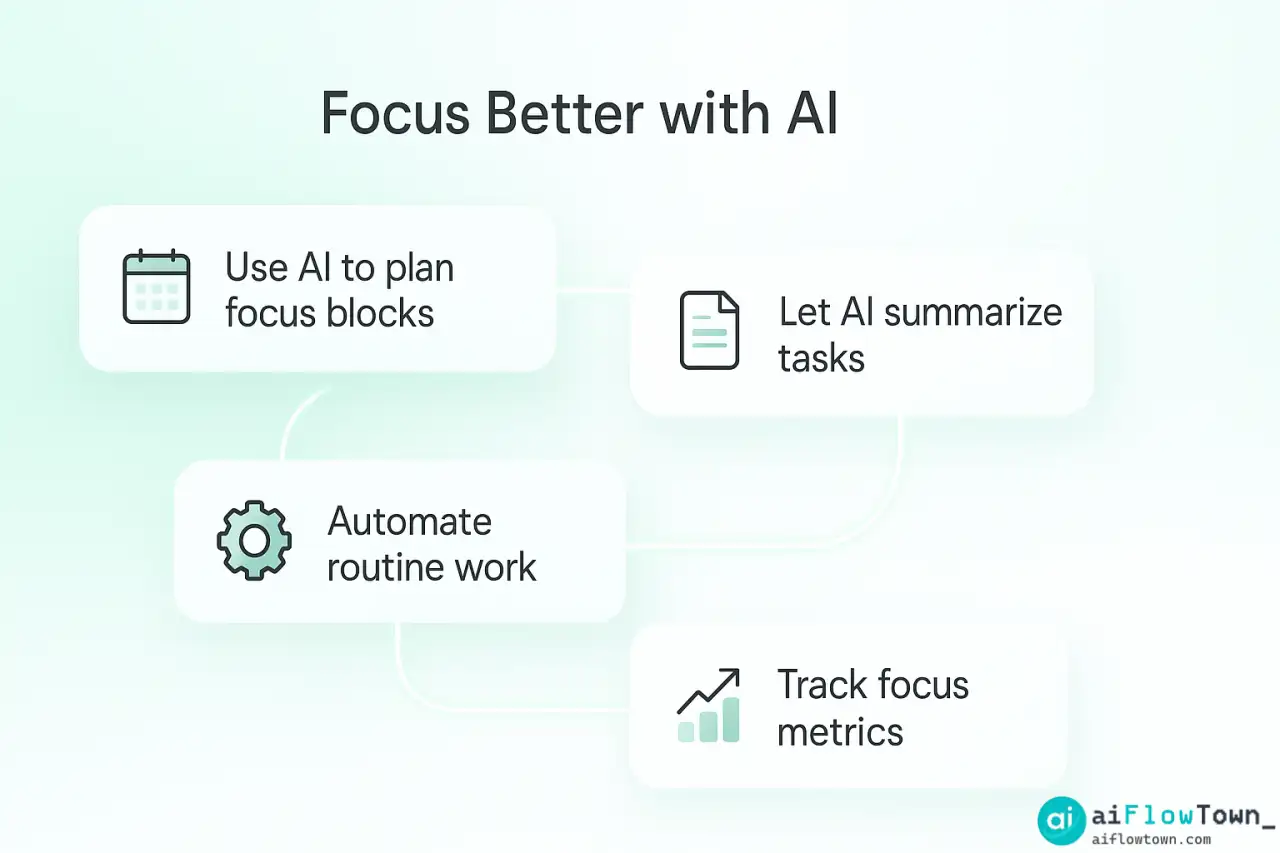
Turn the tool of distraction into a tool for focus. Use AI to help you design the very systems that protect your attention. For example:
- Prompt Example: “Act as a productivity coach. I get most distracted by checking news sites and social media between 1 PM and 3 PM. Design a simple, 3-step ‘afternoon slump’ routine for me that doesn’t involve screens and helps me reset my focus.”
By using AI meta-cognitively—to think about your own work habits—you can leverage its power to build guardrails against its own distracting nature.
Conclusion: The Lever and the Firm Hand
Artificial intelligence is one of the most powerful levers ever handed to humanity. It can amplify our efforts and multiply our output beyond what we thought possible. But a lever is useless without a firm hand to guide it. That hand is your focused attention.
The professionals who will thrive in the coming decade are not those who can simply use AI, but those who can command it without becoming distracted by it. They will be the ones who can seamlessly switch between collaborative sprints with their AI and long, uninterrupted sessions of deep, human-centric thought.
By building intentional habits and robust systems, you can ensure you are staying focused and remain the pilot, not the passenger, in your journey toward a more productive and meaningful professional life. What is the biggest AI-related distraction you face, and which strategy will you try first to combat it?
❓ FAQ
Is AI inherently bad for focus?
Not at all. AI is a tool, and like any powerful tool, its impact depends on how you use it. When used intentionally within a structured workflow (like in “AI Sprints”), it can massively enhance focus by quickly clearing away mundane tasks. The danger comes from unstructured, always-on usage.
How can I stop “prompt tinkering” and just get to work?
The key is to set a hard time limit and embrace the “good enough” principle. Give yourself a maximum of 5-10 minutes for your “Generation Phase.” Get an 80% good output from the AI, and then force yourself to close it. The majority of your time should be spent in the “Creation Phase,” where you refine and add your own unique value.
What if my job requires me to be available and use AI constantly?
Even in a fast-paced environment, you can apply these principles on a micro-scale. Instead of hour-long blocks, think in 25-minute “Pomodoro” cycles. One cycle could be for AI-assisted tasks, and the next for focused writing or analysis. The principle of “batching” similar tasks together is what matters most for reducing cognitive distraction.
✨ Will these techniques make me slower at first?
Possibly, for a day or two. Building any new habit feels slow initially because it requires conscious effort. However, the gains in the quality and depth of your work will quickly outweigh the initial adjustment period. You’ll produce less “fluff” and more high-impact work in the long run, leading to greater overall speed and effectiveness.
⚠️ Reminder: Even the smartest tools / AI can miss small details or make mistakes. Always double-check your work before presenting or publishing it - a quick review can save hours later.