You can’t focus for more than 10 minutes anymore. You start reading an article, check your phone, open another tab, remember an email, return to the article, forget what you just read. Your attention span isn’t laziness—it’s neurological rewiring from years of context-switching. Your brain learned that sustained focus isn’t rewarded, but rapid task-switching is. AI tools can’t magically restore focus, but they can create conditions that make retraining your attention possible by removing friction, reducing decisions, and building focus capacity gradually.
Why Your Focus Broke
You didn’t lose the ability to focus through moral failure. Your brain adapted to an environment that rewards constant context-switching. Every notification, every tab, every “quick check” trained your brain that sustained attention is unnecessary.
The Neuroscience of Broken Focus
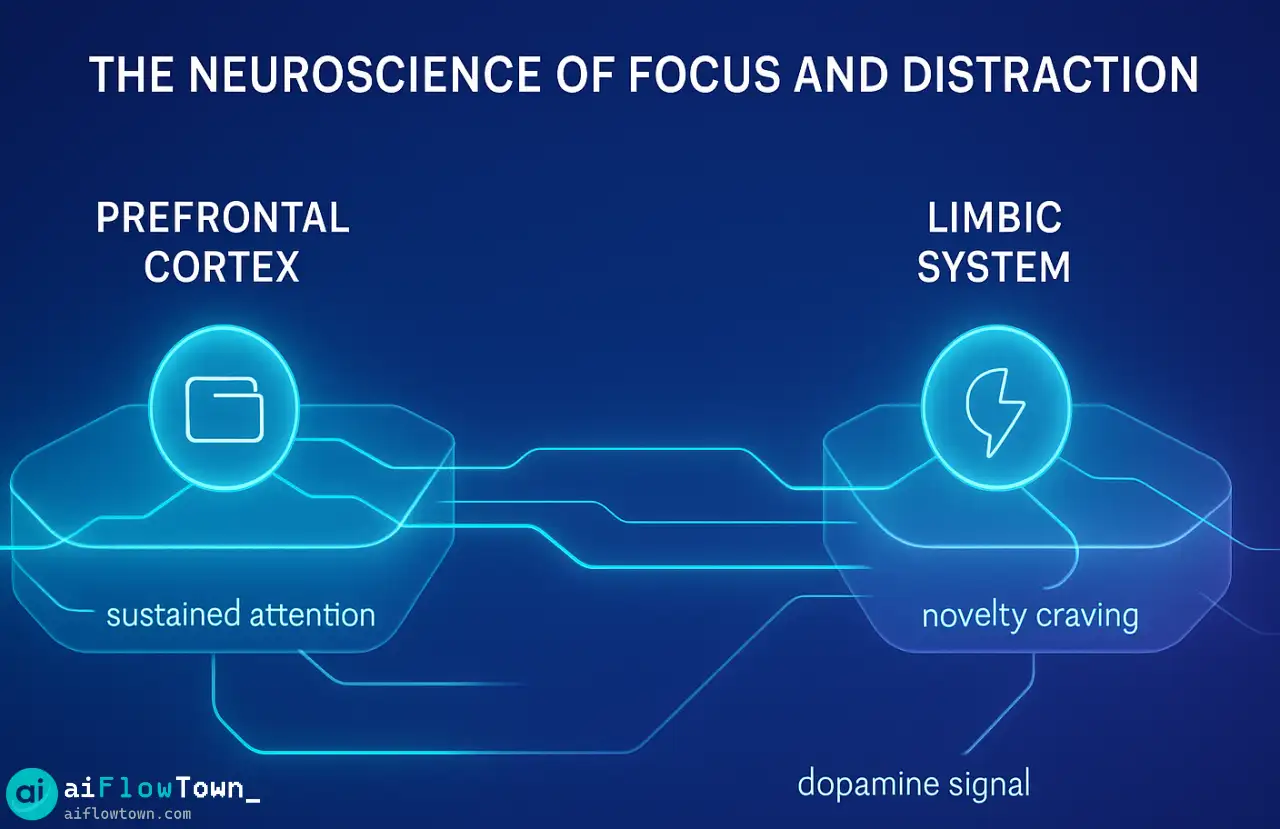
Your brain’s prefrontal cortex—responsible for sustained attention—weakens when underused, like a muscle. Meanwhile, your limbic system—craving novelty and instant rewards—strengthens. This creates a neurological imbalance:
- ⚠️ Depleted attention: Can’t sustain focus on single task
- ⚠️ Heightened distractibility: Everything feels urgent and interesting
- ⚠️ Reduced working memory: Can’t hold complex thoughts
- ⚠️ Decision fatigue: Constant “what should I focus on?” drains energy
- ⚠️ Dopamine dysfunction: Need constant novelty to feel engaged
Understanding these ai focus tips starts with recognizing this isn’t a willpower problem—it’s a training problem. Your brain learned bad habits using how to improve focus with ai tools systematically can help retrain it.
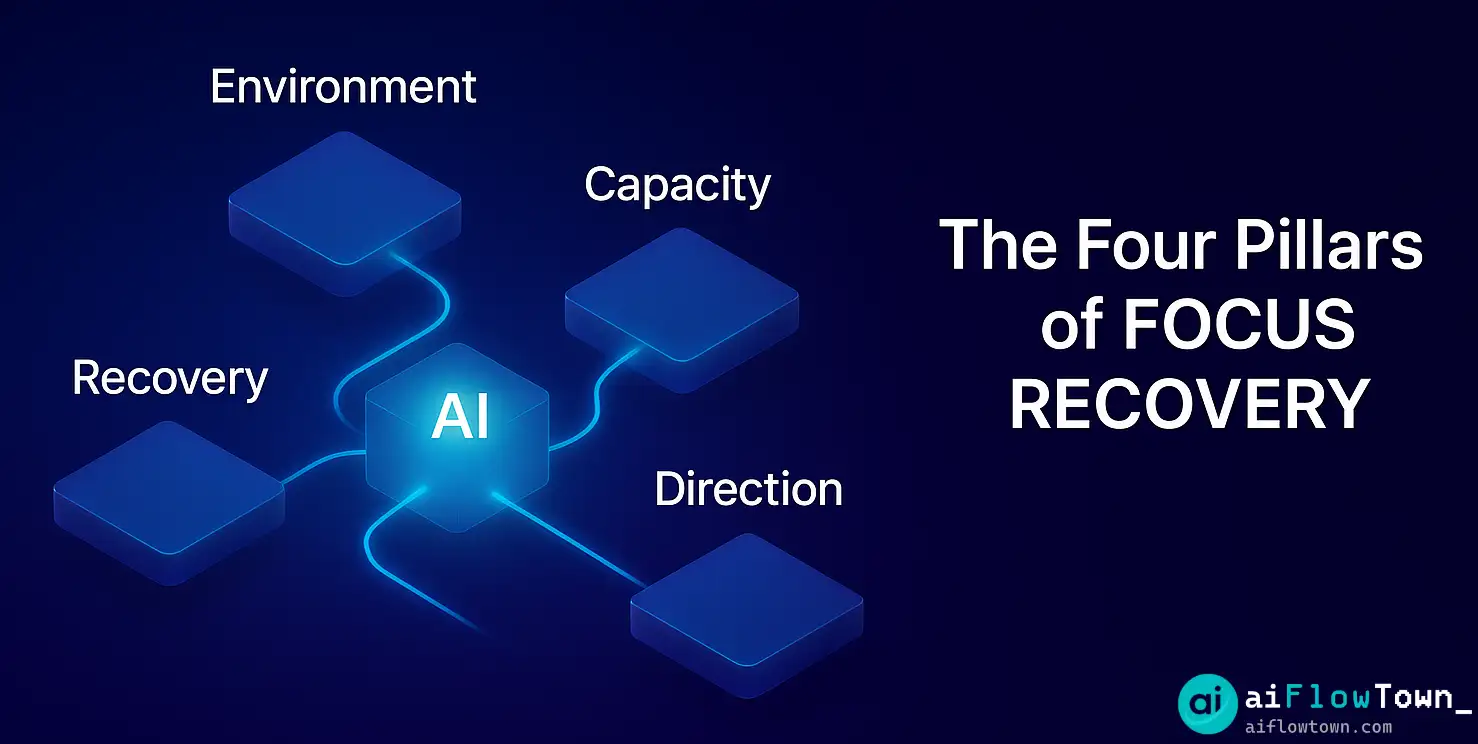
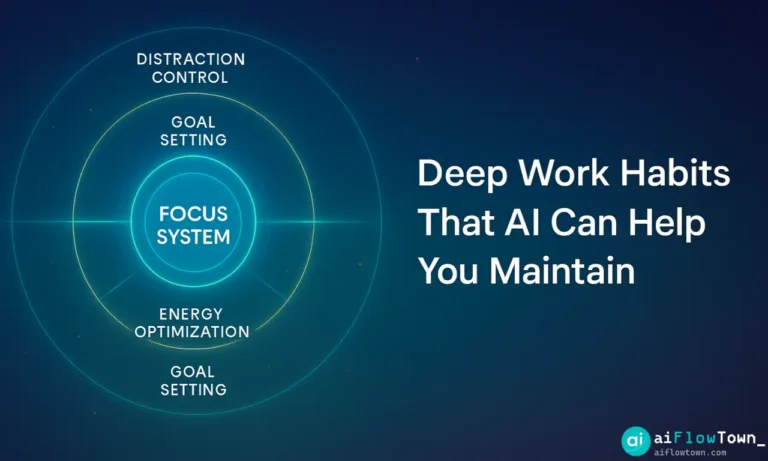
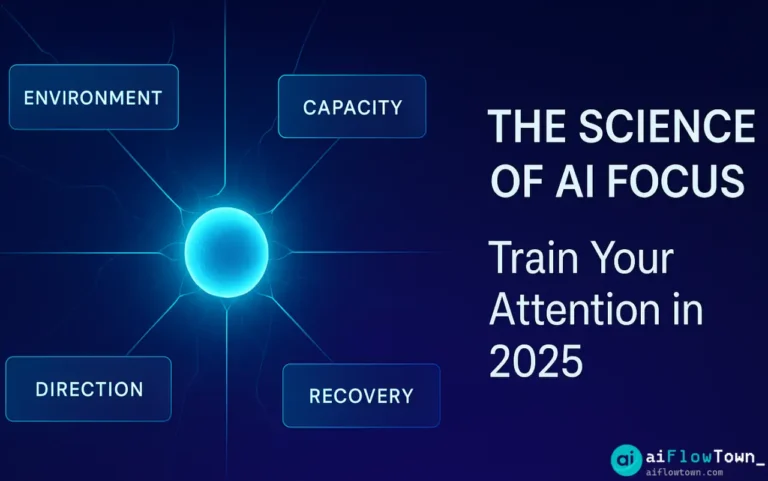
The Four Pillars of Focus Recovery
| Pillar | What It Addresses | AI’s Role |
|---|---|---|
| Environment | External distractions | Automate distraction blocking |
| Capacity | Attention endurance | Progressive training schedules |
| Direction | What to focus on | Remove decision fatigue |
| Recovery | Rest and restoration | Optimize break timing |
Pillar 1: Environment Engineering
AI-Powered Distraction Blocking
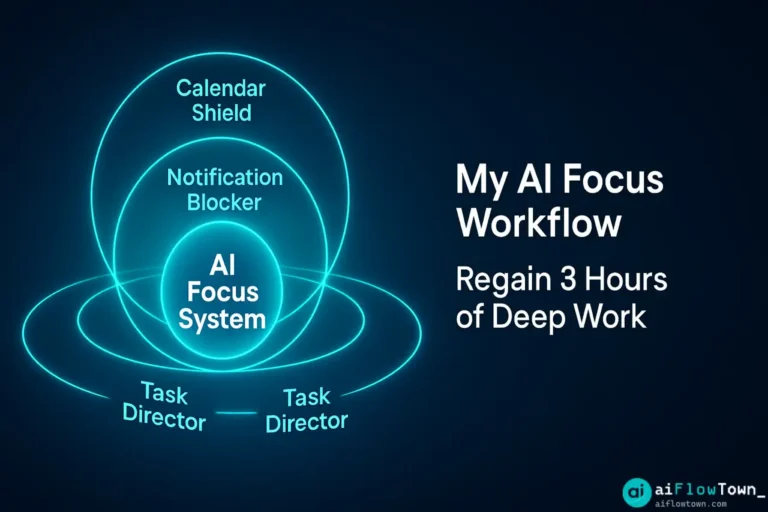
Willpower fails against notifications. Instead, use AI to automate environment control:
Reclaim.ai or Motion:
- Detects "focus blocks" on calendar
- Automatically enables Do Not Disturb
- Pauses Slack notifications
- Blocks distracting websites
- Closes unnecessary apps

Your role: Just show up to focus time
AI's role: Removes friction and temptation
Why this works: Decision to focus happens once when setting up automation, not constantly throughout the day. For more environment strategies, visit AI workflows.
The Notification Diet
AI can analyze which notifications actually matter:
"Analyze my notification patterns over 30 days:
- Which notifications led to action within 1 hour?
- Which sat unread for days?
- Which interrupted deep work unnecessarily?
- What's the optimal notification policy?"

Based on analysis, disable 80% of notifications.
Keep only: [Boss texts, customer alerts, calendar reminders]
Pillar 2: Building Attention Capacity
Progressive Focus Training
You can’t jump from 10-minute attention span to 2-hour deep work. Progressive training using train attention span using technology principles:
Week 1-2: The 15-Minute Protocol
AI-generated daily schedule:

"Design a focus training day:
- 3 focus sessions daily
- Each session: 15 minutes work, 5 minutes break
- Sessions separated by 90+ minutes
- No multitasking during 15 minutes
- Break means: walk, water, stretch (NOT phone/email)

Track: Did I complete 15 minutes without distraction?"
Week 3-4: The 25-Minute Protocol
Once 15 minutes feels manageable, increase to 25 (Pomodoro-style). AI tracks your completion rate and adjusts timing if you’re consistently failing.
Week 5-8: The 45-Minute Protocol
Two 25-minute blocks with 5-minute break between, separated by longer breaks. Total focus time increases while maintaining success rate.
Month 3+: The 90-Minute Protocol
Eventually build to 90-minute deep work sessions—the duration research shows as optimal for creative/analytical work.
AI as Focus Coach
End-of-day reflection prompt:

"Today's focus sessions:
- Attempted: 3 sessions of 25 minutes
- Completed without distraction: 2 sessions
- Broke focus on: checking email mid-session

Analyze:
- Is 25 minutes too long for me right now?
- What pattern led to the failed session?
- Should I adjust session length or timing?
- What environmental factor can I control tomorrow?"
AI identifies patterns you’d miss, suggests adjustments based on actual performance using neuroscience of focus and concentration understanding.
Pillar 3: Removing Decision Fatigue
AI-Directed Work Sessions
Every “what should I work on?” decision drains focus capacity. AI eliminates this:
Morning prompt:

"Based on my calendar and task list:
- I have 3 focus blocks today (9-10:30am, 2-3:30pm, 7-8pm)
- Tasks due this week: [paste task list]

For each focus block, tell me:
- Exactly which task to work on
- Why this task in this block (energy level, deadline, complexity)
- What 'done' looks like for this session

Remove all decision-making. Just tell me: 'At 9am, open [file] and work on [specific task] for 90 minutes.'"
Result: You show up, AI tells you what to do, you execute. Zero energy wasted on “what now?” For more on task management, check AI productivity prompts.
The Single-Task Interface
AI generates daily file: “Today.md”
Contains: Only tasks scheduled for today’s focus blocks
Format: One task visible at a time
When complete: Check off, next task appears
No scrolling through master list, no decisions, just next step– Simplified Task Interface –
Pillar 4: Strategic Recovery
AI-Optimized Break Timing
Breaks aren’t weakness—they’re required for sustained focus. AI determines optimal timing:
"Monitor my focus quality throughout the day. Track:
- Typing speed
- Error rates
- Time between actions
- When I check phone/email

Identify: At what point does my focus quality drop 20%?
That's when I need a break, regardless of clock time.

Suggest break at optimal moment, not arbitrary 25-minute timer."
Active vs Passive Recovery
| Recovery Type | When to Use | AI Suggestion |
|---|---|---|
| Active (movement) | After intense mental work | 5-min walk, stretching |
| Social | When feeling isolated | Quick chat with colleague |
| Creative | When stuck on problem | Doodle, music, different task |
| Rest (eyes closed) | When cognitively depleted | 10-min meditation or nap |
| Avoid | Never during breaks | Social media, email, news |
AI tracks which break types restore your focus best for rebuild deep work capacity with ai assistance.
Measuring Focus Recovery
The Weekly Focus Audit
AI-generated weekly report:

"This week's focus metrics:

Capacity:
- Average sustained focus: 31 minutes (up from 23 last week)
- Longest uninterrupted session: 67 minutes (new record)
- Sessions completed: 14 of 15 planned (93%)

Quality indicators:
- Tasks completed in focus time: 12 (vs 8 multitasking)
- Estimated deep work hours: 8.5 (vs 4.2 fragmented)
- Self-reported focus quality: 7.2/10 (up from 5.8)

Environmental factors:
- Phone checks during focus: 2 (down from 11)
- Email interruptions: 0 (automation working)
- Unplanned meeting invasions: 1 (Friday afternoon)

Recommendation: Ready to increase session length to 35 minutes. Current capacity can support it."
Objective metrics reveal progress invisible to subjective feeling using overcome distraction using ai assistance measurably.
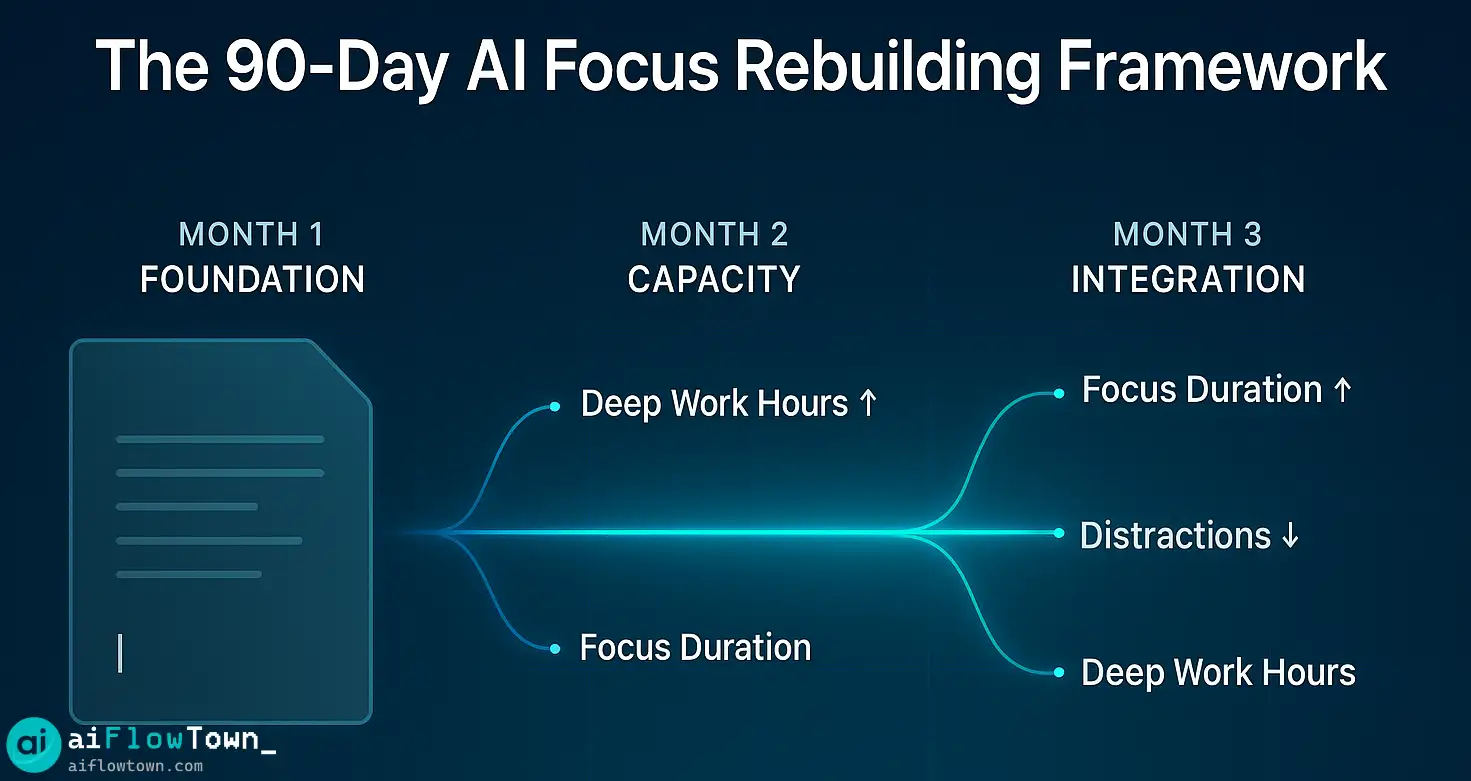
The 90-Day Focus Rebuilding Program
Month 1: Foundation
- Goal: Consistent 15-20 minute focus sessions
- AI role: Environment automation, distraction tracking
- Success metric: Complete 80% of planned sessions
- Key learning: What breaks your focus most often
Month 2: Capacity Building
- Goal: Extend to 30-40 minute sessions
- AI role: Progressive difficulty adjustment, pattern analysis
- Success metric: Sustain longer sessions 70% of time
- Key learning: Optimal break timing and recovery methods
Month 3: Integration
- Goal: Multiple 45-60 minute sessions daily
- AI role: Advanced scheduling, proactive adjustments
- Success metric: 10+ hours deep work weekly
- Key learning: Sustainable focus becomes new normal
Real Example: Software Developer’s Recovery
Starting Point (Week 0)
Marcus, developer, could barely code for 15 minutes without checking Slack or browsing tech news. Estimated deep work: 2 hours weekly across 40-hour workweek.
Implementation
Week 1-4: Used Reclaim.ai to block 3 daily 15-minute focus sessions. Phone in drawer. Slack auto-paused. Failed 40% of sessions initially.
Week 5-8: Increased to 25 minutes. AI tracked that afternoons were hardest—scheduled easier tasks then, complex coding mornings. Success rate: 75%.
Week 9-12: Two 45-minute morning blocks. One 30-minute afternoon block. Used AI to determine exact tasks for each session, eliminating “what should I code?” decisions.
Results After 90 Days
- ✅ Deep work hours: 2 → 12 weekly
- ✅ Average focus duration: 12 min → 52 min
- ✅ Code output: 2x increase (same hours, better focus)
- ✅ Bug rate: 30% decrease (fewer context-switching errors)
- ✅ Subjective: “I can think again. Complex problems don’t feel overwhelming.”
For more focus strategies, visit mindset and focus.
❓ FAQ
⏰ How long until I notice improvement?
Week 1-2: Little noticeable change, feels like struggle. Week 3-4: Moments where focus feels easier. Week 6-8: Consistent improvement in session completion. Month 3: Focus feels “normal” again, not constant battle. Full recovery: 3-6 months depending on starting point.
Do I have to quit social media entirely?
No, but you must eliminate it during focus time. Use apps like Freedom or Cold Turkey to block during work hours. Social media during breaks still destroys recovery—scroll Twitter after work, not between focus sessions. Gradual reduction works better than cold turkey.
What if I have ADHD?
These techniques still help but may need adjustment. Shorter initial sessions (10 min), more frequent breaks, different types of breaks (movement-based). AI tracking especially valuable—reveals patterns specific to your neurology. Consider combining with professional treatment, not replacing it.
What if my job requires constant availability?
Even 30 minutes daily of protected deep work helps. Negotiate with manager: “I’ll be unreachable 9-9:30am for complex work, fully responsive rest of day.” Most bosses agree when you explain productivity impact. For emergencies, keep phone accessible but on DND with VIP breakthrough.
How do I know if it’s working?
Track weekly: How long can you sustain focus before first distraction? How many planned focus sessions did you complete? How much deep work output vs input time? Subjective feeling lags behind objective improvement—trust the metrics when motivation wanes.
Final Thoughts
Your broken attention span isn’t permanent brain damage—it’s learned behavior that can be unlearned. The ai focus tips in this guide work because they address root causes: environmental chaos, insufficient capacity, decision fatigue, and poor recovery. AI doesn’t magically fix focus, but it removes friction that makes focus training impossible.
Start this week with one change: automate environment control so your focus blocks are actually protected. Build from there. Progress won’t be linear—some weeks you’ll regress. The difference between people who rebuild focus and those who don’t isn’t talent or willpower. It’s consistent practice of progressively harder focus sessions in controlled environments.
Three months from now, you’ll read this and barely remember what chronic distraction felt like. Your brain will have adapted back to sustained attention being the default, not the exception. The work is rebuilding that neurological pathway one focused session at a time.
Next: Combine these focus techniques with practical workflow optimizations in our guide to quick productivity hacks you can implement today for maximum efficiency.
⚠️ Reminder: Even the smartest tools / AI can miss small details or make mistakes. Always double-check your work before presenting or publishing it - a quick review can save hours later.