Why Are People Buying and Selling Prompts?
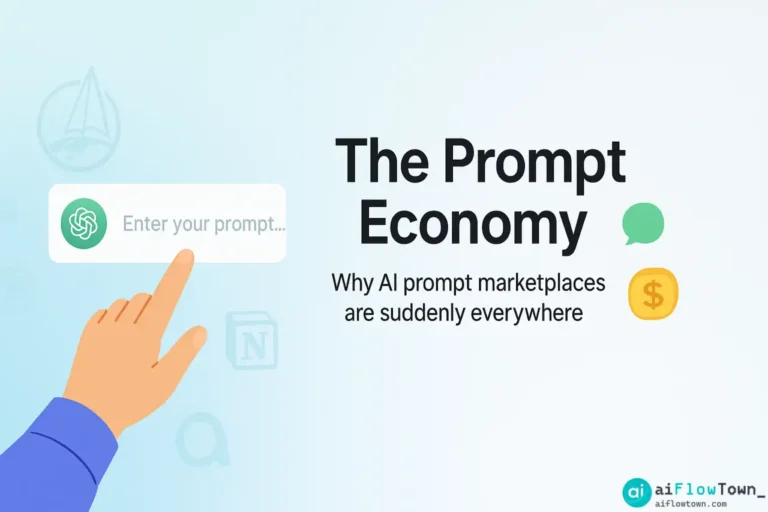
Just a short time ago, the idea of paying money for a string of text would have seemed absurd. Yet today, a simple search reveals a booming new digital economy. Websites are popping up where individuals are buying and selling “prompts”—carefully crafted instructions for AI models like ChatGPT—for anywhere from a few dollars to hundreds.
Welcome to the world of prompt marketplaces, a phenomenon that signals a fundamental shift in how we value digital skills. But why is this happening now? What has turned simple text into a valuable commodity? This isn’t just a fleeting trend; it’s the birth of a new micro-economy built on a simple premise: the quality of an AI’s output is directly proportional to the quality of the input. As millions of people gain access to powerful AI, a significant gap has emerged between what the AI can do and what most users know how to ask it to do.
This guide will explore the forces driving this explosion. We’ll look at the psychology of the buyers, the skills of the sellers, and answer the critical question: are prompt marketplaces a sustainable part of our AI-driven future, or just a temporary gold rush?
Part 1: The Core Problem – The “Skill Gap” in AI Communication
Access to a powerful tool does not guarantee powerful results. Giving everyone a Formula 1 car doesn’t make everyone a racing driver. The same is true for AI. While millions can use ChatGPT, only a fraction can use it to its full potential. This creates a “skill gap.”
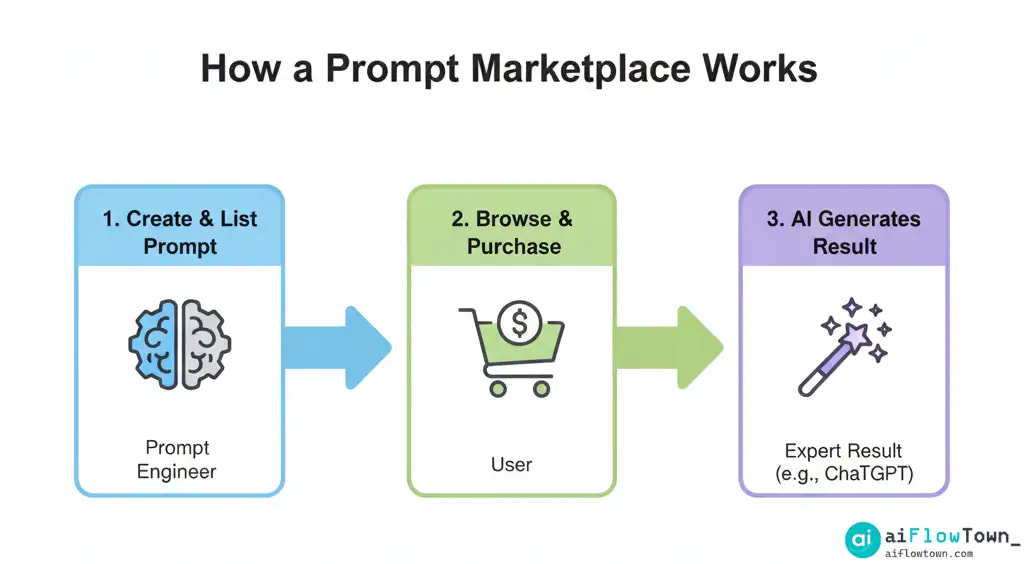
On one side, you have the majority of users who write simple, one-line prompts and get generic, often underwhelming results. On the other, you have a growing class of individuals—often called “prompt engineers”—who have mastered the art of crafting detailed, context-rich instructions that can coax incredible outputs from the same AI. Prompt marketplaces exist to bridge this gap. They allow those with less skill or time to essentially “rent the expertise” of a skilled prompter, packaged as a ready-to-use product.
A great prompt is more than just a question. It’s a miniature computer program written in natural language, designed to constrain the AI’s vast potential into a specific, desired outcome.
Part 2: Deconstructing the Value – What Are People Actually Buying?
When someone buys a prompt, they’re not just buying text. They are buying a combination of three valuable assets:
- Expertise & Domain Knowledge: The best prompts are not written by AI generalists. A prompt to generate a legal contract is crafted by someone who understands legal language. A prompt to create a marketing campaign is built on deep marketing principles. Buyers are paying for the specialized knowledge embedded within the prompt’s structure.
- Time & Iteration: A perfect prompt is rarely written on the first try. It often takes hours of testing, refining, and iterating to get the desired output consistently. Buyers are paying to skip this time-consuming process. They are buying a proven, battle-tested solution.
- Structure & Repeatability: A good prompt is a repeatable system. The “Midjourney Prompt for Photorealistic Logos” can be used hundreds of times. Buyers are purchasing a workflow, a tool that provides consistent results every time they use it, turning a creative art into a reliable process. For more on this, our guide to AI productivity prompts explores how to build these systems.
Part 3: The Key Players in the Prompt Economy
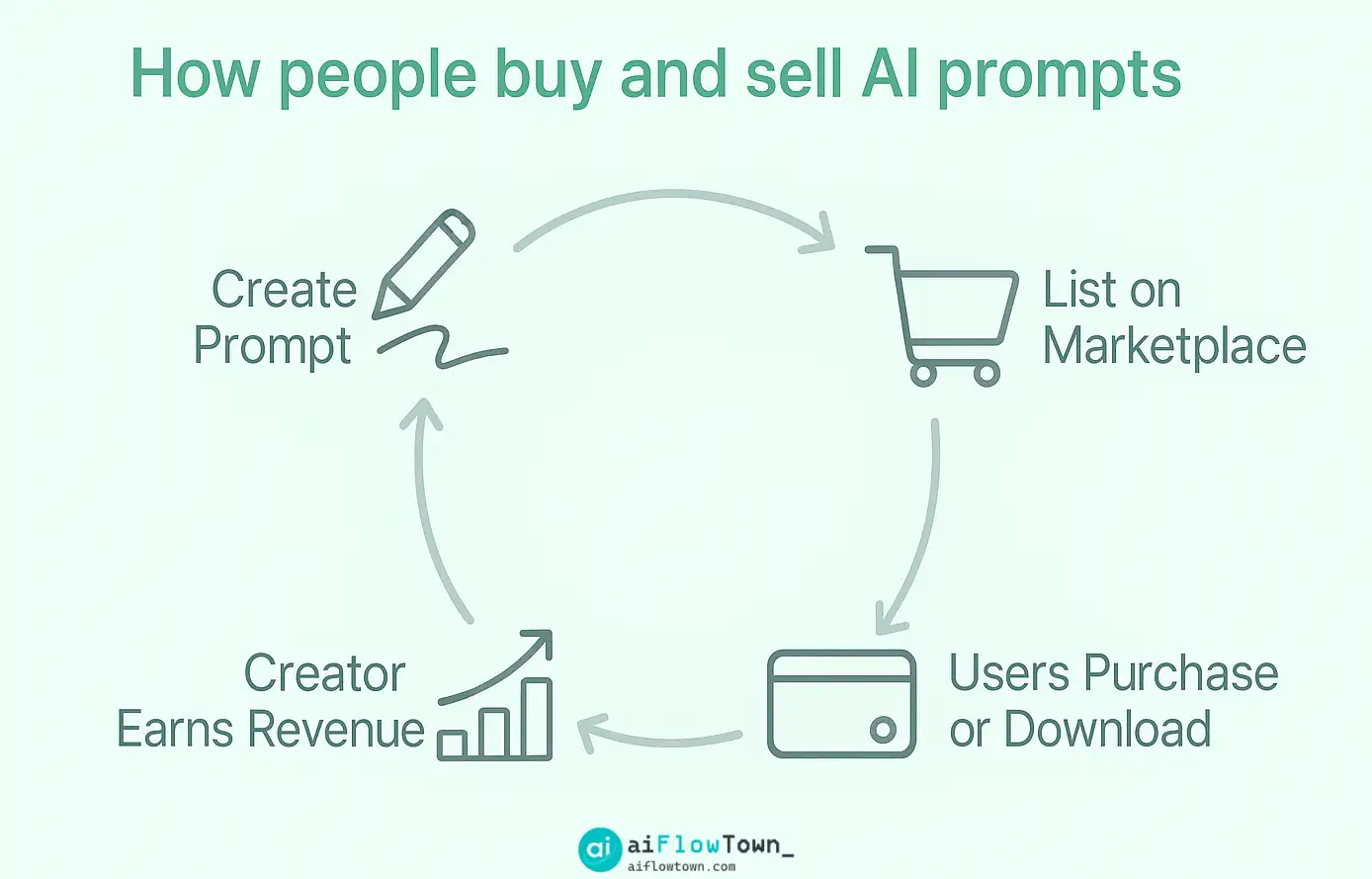
This new market has created two distinct roles. Understanding their motivations is key to understanding why the market is growing so quickly.
| The Player | Who They Are | Primary Motivation | What They Sell/Buy |
|---|---|---|---|
| The Prompt Seller (The “Engineer”) | Developers, marketers, artists, writers, and domain experts who have invested time in mastering AI prompting. | To monetizing AI skills and create a scalable digital product from their expertise. | Sells well-structured, tested prompts that solve a specific problem (e.g., “Prompt for creating a detailed SEO blog outline”). |
| The Prompt Buyer (The “User”) | Freelancers, small business owners, students, and professionals who need high-quality AI results but lack the time or skill to craft expert prompts. | To save time, improve the quality of their work, and access expert-level results without the steep learning curve. | Buys prompts to accelerate their workflow (e.g., “Prompt to generate 30 social media posts from a blog article”). |
This symbiotic relationship—sellers packaging expertise and buyers purchasing efficiency—is the engine driving the growth of the best prompt marketplaces like PromptBase, as highlighted by tech publications like TechCrunch.
Part 4: The Future of Prompt Engineering and Marketplaces
Is this just a fad? As AI models become more intuitive, will the need for expert prompts disappear? The consensus is: probably not. While the “floor” for getting decent results from AI will rise, the “ceiling” for what’s possible with expert prompting will also rise. The future of prompt engineering is likely to evolve in two directions:
- Increased Specialization: The market will move from generic prompts (“Write a blog post”) to hyper-specific, expert-level prompts (“Generate a Python script for sentiment analysis using the VADER library on a CSV file”).
- Integration into Tools: The logic behind successful prompts will be abstracted away and built directly into software. Instead of buying a prompt, you’ll buy a SaaS tool or a plugin that has the expert prompting logic built-in. This aligns with the broader trend of embedding AI into all tools and apps.
The role of the “prompt engineer” may become less about writing individual prompts and more about designing and curating the complex prompt chains that power these next-generation applications.
Conclusion: A New Class of Digital Asset
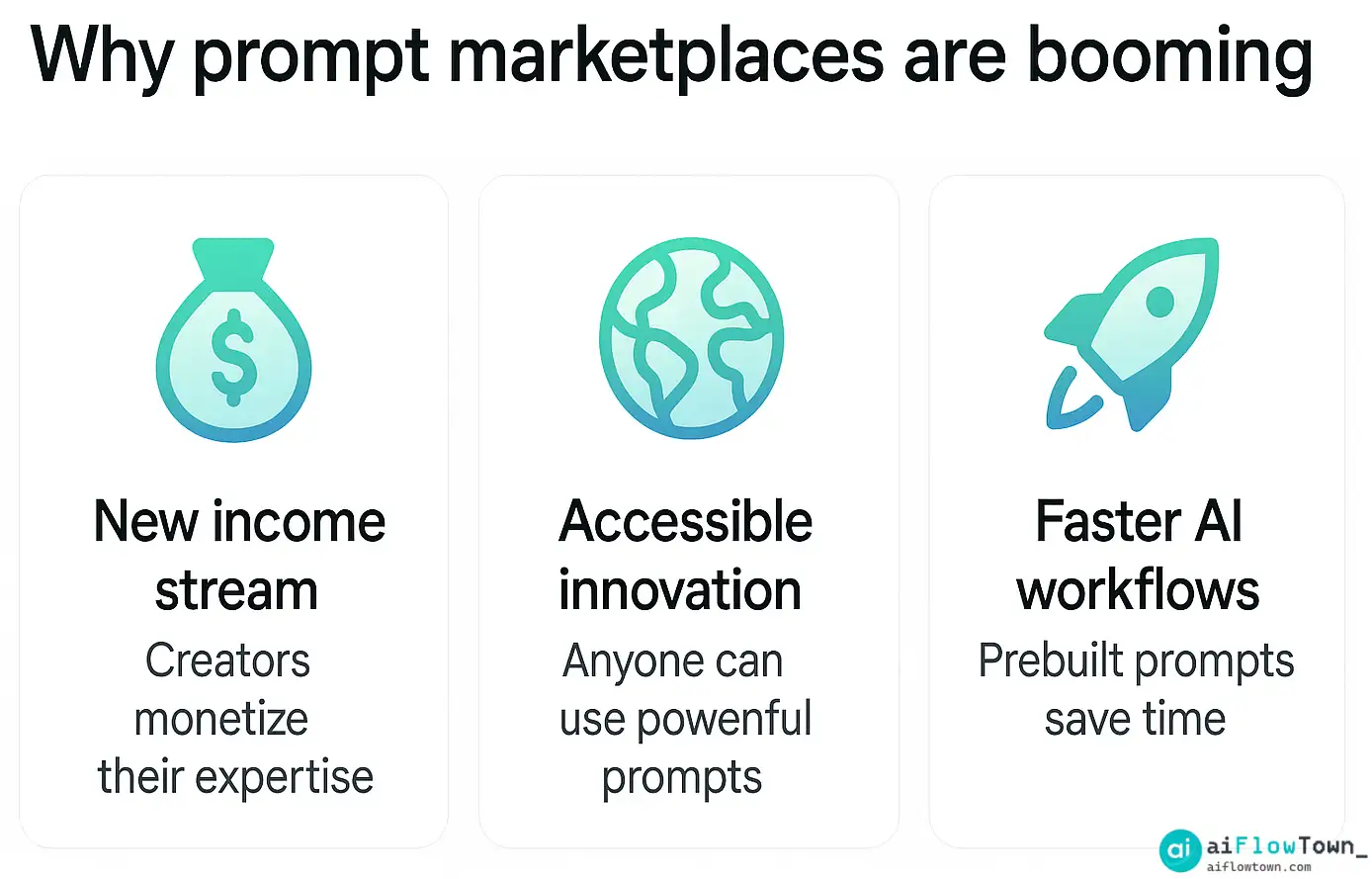
The explosion of prompt marketplaces is more than just a trend; it’s a validation that in the age of AI, the ability to ask the right question is a skill as valuable as the ability to code or design. These platforms have effectively created a new class of digital asset: a repeatable, scalable, and valuable piece of intellectual property packaged as a simple string of text.
While the market will undoubtedly mature and change, the underlying principle remains. As long as there is a gap between the potential of AI and the ability of the average user to access it, there will be a market for the keys that unlock that potential. Those keys are well-crafted prompts.
❓ FAQ
Is selling prompts profitable?
It can be. For top sellers with niche expertise and high-quality, in-demand prompts, it can become a significant source of passive income. However, like any creator economy, the market is competitive. Success depends on identifying a specific pain point and creating a prompt that solves it better than anyone else.
What is a prompt engineer, and how do I become one?
A prompt engineer is someone who specializes in designing, testing, and refining instructions for AI models to achieve specific, high-quality outcomes. To become one, you need a combination of language skills, logical thinking, and domain expertise in a particular field (like marketing, coding, or art). The best way to start is by practicing and building a portfolio of your most effective prompts.
What are the best prompt marketplaces to buy or sell prompts?
Some of the most popular platforms today include PromptBase, PromptSea, and marketplaces integrated into specific tools like the official GPT Store. Each has its own focus, with some being better for artistic prompts (Midjourney) and others for business and writing prompts (ChatGPT).
❗ Are there any risks to buying prompts?
The main risk is low quality. A poorly designed prompt will not deliver the promised results. Always buy from sellers with good reviews and clear examples of the output. Also, be aware that you are buying the instruction, not a guarantee of a specific outcome, as AI models can sometimes be unpredictable.
⚠️ Reminder: Even the smartest tools / AI can miss small details or make mistakes. Always double-check your work before presenting or publishing it - a quick review can save hours later.