Why Creative Blocks Happen
You know your product, your audience, and your channels intimately. This expertise is valuable but creates constraints. When brainstorming, your brain automatically filters out ideas that seem impractical based on past experience. You think “we tried social media contests before, they don’t work” before fully exploring the concept. This pre-filtering kills interesting ideas before they’re developed.
Marketing teams get stuck in these patterns:
- ⚠️ Defaulting to what competitors do
- ⚠️ Repeating last year’s campaigns with minor tweaks
- ⚠️ Avoiding “weird” ideas that might actually stand out
- ⚠️ Brainstorming in teams where junior people defer to senior
- ⚠️ Dismissing ideas too quickly without exploration
Using ai brainstorming prompts generates ideas without these biases. AI doesn’t know what “didn’t work last time” or what your boss thinks is too risky. It just generates possibilities using how to use ai to brainstorm marketing ideas systematically, then you apply strategic filtering. For more marketing strategies, visit AI productivity prompts.
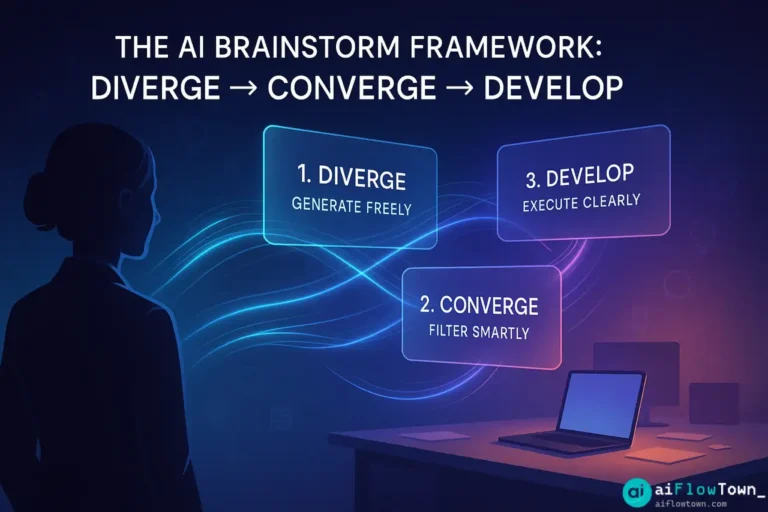
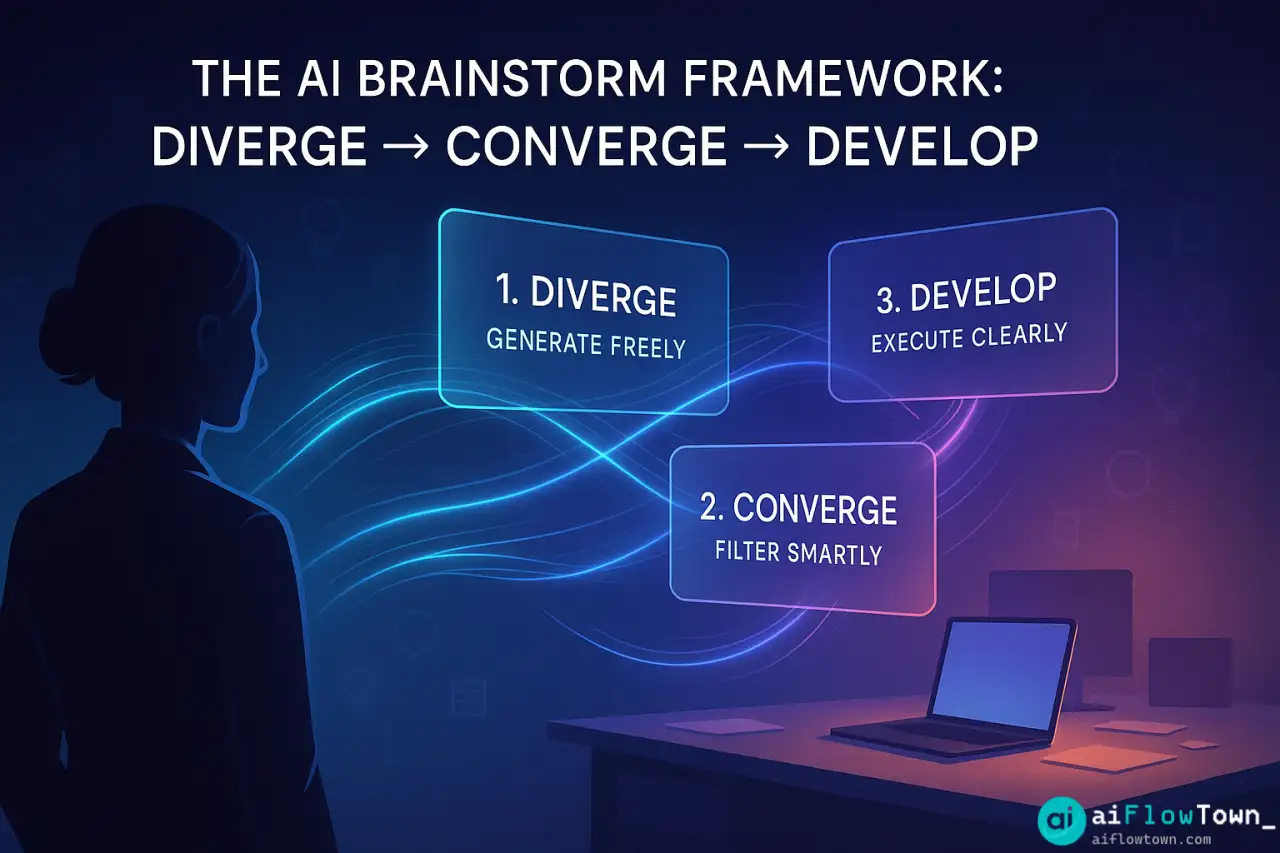
The Brainstorming Framework
Three-Stage Process
| Stage | Goal | Mindset |
|---|---|---|
| 1. Diverge | Generate 50+ ideas without judgment | Quantity over quality, embrace weird |
| 2. Converge | Filter to 10-15 viable concepts | Apply strategic criteria |
| 3. Develop | Flesh out top 3-5 with details | Make it actionable |
Most teams skip straight to convergence, which kills creativity. Separate generation from evaluation using generate creative campaign concepts with chatgpt effectively. Learn more at AI workflow examples.
The Core Brainstorming Prompt
Start with maximum context, minimum constraints:
"Generate marketing campaign ideas for me.

Product/Service: [What you sell and key benefits]
Target audience: [Who buys, their pain points, demographics]
Current channels: [Where you market now]
Budget tier: [Low/Medium/High - gives AI realistic scope]
Campaign goal: [Awareness/Leads/Sales/Retention]

Our brand voice: [Professional/Playful/Educational/Bold - be specific]
What makes us different: [Unique positioning vs competitors]

Generate 30 campaign ideas that:
1. Stand out from typical B2B/B2C marketing
2. Are creative but executable
3. Leverage our unique strengths
4. Range from safe to bold (mix of both)
5. Span different channels and formats

For each idea provide:
- Concept name (catchy, memorable)
- One-line description
- Primary channel
- Why it would work for our audience
- Estimated complexity (Low/Medium/High)

Don't filter for feasibility yet—prioritize originality and variety."
This structured approach ensures brainstorm content ideas using ai tools with enough context to be relevant but enough freedom to surprise you. For more prompts, check productivity flow hacks.
The Filtering Process
Evaluating AI-Generated Ideas
Once you have 30+ ideas, apply strategic filters:
"Review these 30 marketing ideas against our constraints:

Hard constraints (must meet these):
- Budget: [Specific amount]
- Timeline: [When campaign needs to launch]
- Team capacity: [How many people available]
- Brand guidelines: [What we can't do]
- Legal/compliance: [Industry restrictions]

Scoring criteria (rate each 1-10):
- Audience fit (does this resonate with our specific customers?)
- Differentiation (how unique vs competitor activity?)
- Measurability (can we track ROI clearly?)
- Scalability (if it works, can we expand it?)
- Risk level (what's downside if it flops?)

For each idea that passes hard constraints:
1. Assign scores for each criterion
2. Calculate total score
3. Rank top 15 ideas
4. Flag 3-5 "high potential" for development

Be honest about feasibility without killing creativity entirely."
This systematic evaluation uses validate marketing ideas with ai assistance objectively.
The “Yes, And” Refinement
For top ideas, improve rather than reject:
“I like idea #7 but it’s too expensive. How could we achieve the same core concept with 50% less budget? What’s the minimum viable version that tests the hypothesis?”
AI helps salvage interesting concepts that fail initial constraints.
Developing Copy and Visuals
From Concept to Campaign Assets
Once you’ve selected top 3 ideas, flesh them out:
"Develop this campaign idea into actionable plan:

Concept: [Chosen idea from brainstorm]

Create:

1. Campaign messaging:
- Headline (attention-grabbing)
- Subhead (clarifies value)
- Body copy (3 variations: short/medium/long)
- Call-to-action (3 variations to test)

2. Visual direction:
- Describe visual style (colors, imagery, mood)
- Suggest 5 specific visual concepts
- Reference styles (e.g., "like [brand X] but more [Y]")

3. Channel breakdown:
- Primary channel strategy
- Supporting channels
- Content format for each (video/image/text)
- Posting cadence

4. Success metrics:
- What we're measuring
- Target numbers
- How we'll track

5. Timeline:
- Week-by-week rollout plan
- Key milestones
- Decision points (when to double-down or pivot)

Make this actionable enough that team can execute without further strategizing."
This transforms abstract ideas into concrete campaigns using creative brainstorming workflow with ai prompts end-to-end.
Copy Variations for Testing
Generate multiple angles for A/B testing:
"For this campaign, write 5 different angles:

1. Pain-focused: Emphasize problem we solve
2. Benefit-focused: Emphasize outcome they get
3. Fear-based: What they risk by not acting
4. Aspiration-based: Who they become with our solution
5. Proof-based: Lead with results/testimonials

Each angle gets: headline, 2-sentence body, CTA
Same core message, different psychological approach"
Real Case: SaaS Product Launch
The Challenge
A project management SaaS needed launch campaign ideas. Traditional brainstorm produced:
- ❌ “Productivity tips” blog series (done by everyone)
- ❌ LinkedIn ad campaign (obvious, expensive)
- ❌ Customer testimonials (important but not creative)
- ❌ Free trial promotion (expected)
All solid tactics, zero differentiation.
The AI Brainstorm
Using the framework above, AI generated 30 ideas. Top 5 after filtering:
1. “Project Disaster Stories”
User-submitted stories of project failures, turned into entertaining case studies showing how proper tool would have prevented disaster. Build community, SEO content, viral potential.2. “PM Confession Booth”
Anonymous Twitter account sharing project management confessions from industry. Builds following, shows understanding of pain points, naturally leads to product as solution.3. “90-Day Project Challenge”
Free course teaching project management, participants use our tool to complete. Educational value builds trust, natural product adoption, creates case studies.4. “Behind the Chaos”
Video series visiting chaotic companies, documenting their project management nightmares, implementing our tool, showing transformation. Reality TV meets marketing.5. “The PM Survival Kit”
Physical kit with tools/snacks/humor items for project managers, includes trial code. Memorable, shareable, positions product as essential PM tool.– Creative Campaign Concepts –
Implementation and Results
They chose #1 (Project Disaster Stories) and #3 (90-Day Challenge):
- ✅ Disaster Stories generated 47 submissions first month
- ✅ Top stories got 15k+ social shares
- ✅ SEO traffic increased 230% (ranking for “project management fails”)
- ✅ 90-Day Challenge enrolled 340 companies
- ✅ Challenge completion rate: 68%
- ✅ Conversion to paid: 34% of completers
- ✅ Combined campaigns: 3.2x ROI vs traditional launches
None of these ideas came from the human brainstorm. AI suggested, humans refined and executed.
Bonus: Industry-Specific Prompts
For B2B Services
"Focus on: thought leadership, demonstrating expertise, building trust
Avoid: consumer-style virality, entertainment over education
Channels: LinkedIn, industry publications, webinars, case studies"
For E-commerce
"Focus on: visual content, user-generated content, seasonal hooks
Channels: Instagram, TikTok, Pinterest, influencer partnerships
Consider: unboxing experiences, styling content, community building"
For Local Businesses
"Focus on: community involvement, local partnerships, word-of-mouth triggers
Channels: Google My Business, local Facebook groups, community events
Consider: how to make customers want to tell their neighbors"
❓ FAQ
Are AI ideas original or just remixes?
AI combines patterns from training data in new ways—similar to how humans brainstorm. The originality comes from unexpected combinations and applications to your specific context. Always add your unique spin to AI suggestions.
What if all the ideas are bad?
Refine your prompt with more context. Bad output usually means: too vague about audience, unclear about brand positioning, or insufficient constraints. Give AI more to work with—describe 3 past campaigns (what worked/didn’t) to calibrate better.
Should the whole team brainstorm with AI?
Have 2-3 people independently brainstorm with AI, then combine results. This creates variety since different prompters get different ideas. Then evaluate together as team. Prevents groupthink while leveraging collective judgment.
⚡ How many ideas should I generate?
Minimum 30 for adequate variety. 50+ for major campaigns. More initial ideas = higher chance of finding gold. Generating is cheap (10 minutes), execution is expensive—spend time on generation to improve what you execute.
Can I use the same prompt repeatedly?
Yes, but add “avoid these concepts: [previous ideas]” to prevent repetition. Or vary the prompt: “give me ideas competitors wouldn’t think of” vs “give me proven concepts adapted to our niche.” Different framings unlock different idea spaces.
Final Thoughts
Marketing creativity isn’t magic—it’s exploring enough possibilities to find what resonates. AI brainstorming prompts compress weeks of ideation into hours by generating diverse concepts you’d never reach through conventional thinking. The AI doesn’t replace your strategic judgment—it expands the option set before you apply that judgment.
Next campaign, try this: spend 30 minutes generating 50 AI ideas before your team meeting. Bring the top 10 to the meeting. Watch how having interesting options on the table transforms the discussion from “what should we do?” to “which of these great ideas fits best?”
Your next breakthrough campaign is hiding somewhere in idea #37 of an AI brainstorm. You just need to generate enough ideas to find it.
⚠️ Reminder: Even the smartest tools / AI can miss small details or make mistakes. Always double-check your work before presenting or publishing it - a quick review can save hours later.