Introduction
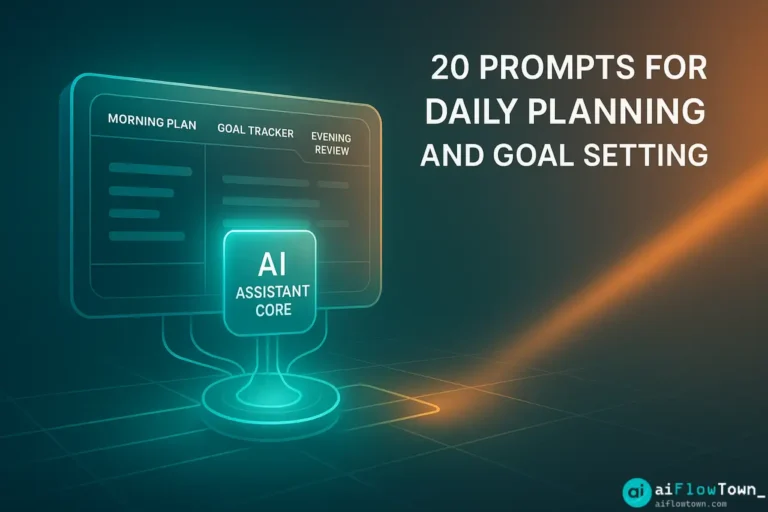
You start most days without a clear plan. Check email, react to messages, jump between tasks, end the day wondering what you actually accomplished. Planning takes mental energy you don’t have at 7am. These 20 AI prompts do the cognitive work for you: they help you prioritize, allocate time realistically, identify blockers, and set goals that actually motivate. Instead of vague “be more productive,” you get specific plans you can execute. Five minutes of AI-assisted planning saves hours of wandering.
Why Daily Planning Fails Without Structure
Most people don’t plan because:
- ⚠️ Decision paralysis: Too many tasks, unclear priorities
- ⚠️ Optimism bias: Schedule 12 hours of work in 8-hour day
- ⚠️ Context missing: Don’t account for energy levels, meetings, interruptions
- ⚠️ Goal vagueness: “Be productive” isn’t actionable
- ⚠️ No adaptation: Plans rigid, reality fluid—causes plan abandonment
These daily planning prompts provide frameworks that account for reality, not fantasy schedules using ai prompts for goal setting and tracking systematically.
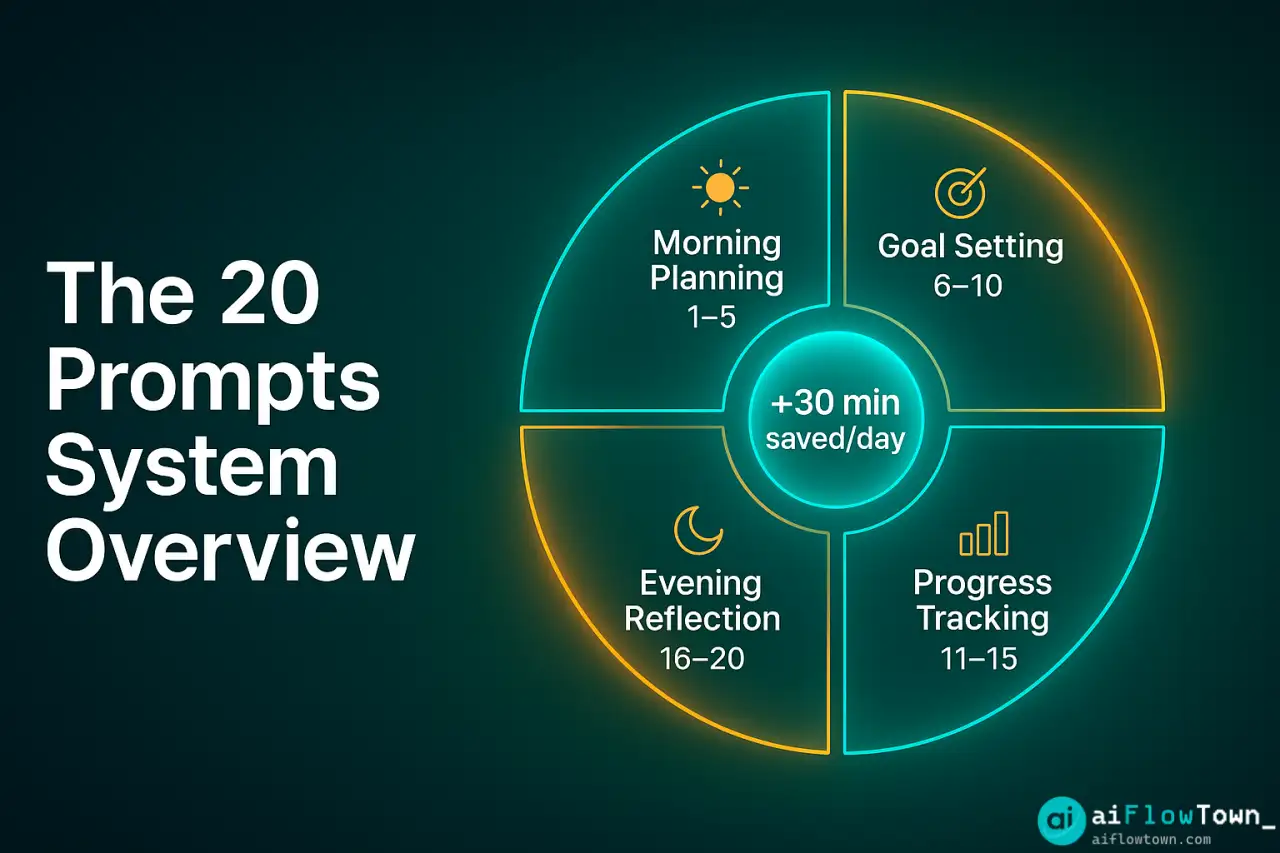
Morning Planning Prompts (1-5)
Prompt 1: The Realistic Day Design
"Plan my day realistically:

Available hours: [Start time - End time]
Fixed commitments: [Meetings, appointments]
Task list: [Everything I want to do]
Energy pattern: [High energy: morning/afternoon/evening]
Typical interruptions: [Emails, Slack, phone calls - estimate time]

Create schedule that:
- Accounts for actual available time (minus meetings and buffer)
- Places hard tasks during high-energy periods
- Includes 20% buffer for interruptions
- Caps at [X] hours (no hero schedules)
- Deprioritizes what doesn't fit

Be honest—what can I realistically accomplish today?"
This creates plan your day with chatgpt prompts that work with reality, not against it.
Prompt 2: The Priority Matrix
"Prioritize today's tasks using Eisenhower Matrix:

My tasks: [List everything]

Categorize each as:
- Urgent + Important: Do first (max 3 tasks)
- Important but not urgent: Schedule specific time
- Urgent but not important: Delegate or quick-handle
- Neither: Drop or defer

Then tell me:
1. Which 3 tasks I MUST do today
2. Which tasks to schedule for later this week
3. Which tasks to eliminate
4. Reasoning for each categorization"
Prompt 3: The Energy-Based Scheduler
"Match tasks to my energy levels:

High-energy task list: [Complex, creative, deep work tasks]
Low-energy task list: [Admin, emails, simple tasks]
My peak energy: [Time of day]
My low energy: [Time of day]

Create schedule:
- Peak hours → Most important deep work
- Mid-energy → Meetings and collaboration
- Low energy → Admin and reactive tasks
- Include strategic breaks before energy crashes

Optimize for energy, not arbitrary time slots."
Prompt 4: The Time-Blocking Template
"Create time blocks for my day:

Available: [Hours]
Must do: [Critical tasks with estimated duration]
Should do: [Important tasks with estimated duration]
Nice to do: [Optional tasks]

Generate calendar blocks:
- 90-min deep work sessions (max 2-3 per day)
- 25-min task sprints for smaller items
- 15-min buffers between blocks
- 30-min lunch/rest
- End-of-day review (10 min)

Format as: [Time] - [Task] - [Expected outcome]
Ensure no block longer than 90 minutes without break."
Prompt 5: The Single Focus Day
"I'm overwhelmed by options. Help me focus:

All possible tasks: [Complete list]
Deadlines: [What's urgent]
Long-term goals: [What moves me forward]

Answer:
1. If I could only accomplish ONE thing today, what should it be?
2. Why is this the highest leverage task?
3. What 2-3 supporting tasks would help complete it?
4. What should I deliberately ignore today?

Give me a single-focus plan, not a scattered to-do list."
For more planning strategies, visit AI productivity prompts.
Goal-Setting Prompts (6-10)
Prompt 6: The SMART Goal Converter
"Turn my vague goal into SMART goal:

Vague goal: [e.g., "Get healthier" or "Grow my business"]

Context:
- Current state: [Where I am now]
- Resources: [Time, money, tools available]
- Constraints: [What limits me]

Create SMART goal with:
- Specific: Exactly what will I achieve?
- Measurable: How will I track progress?
- Achievable: Is this realistic given my constraints?
- Relevant: Why does this matter to bigger picture?
- Time-bound: By when will I complete it?

Then break into 3 milestone sub-goals."
Prompt 7: The Backward Planning Method
"Work backward from my goal:

Final goal: [What I want to achieve]
Target date: [When I want it done]
Today's date: [Current date]

Create reverse timeline:
1. What must be true the day before completion?
2. What must be done a week before that?
3. What must be done a month before that?
4. Continue backward to today
5. Identify first action I should take this week

Make each step concrete and measurable."
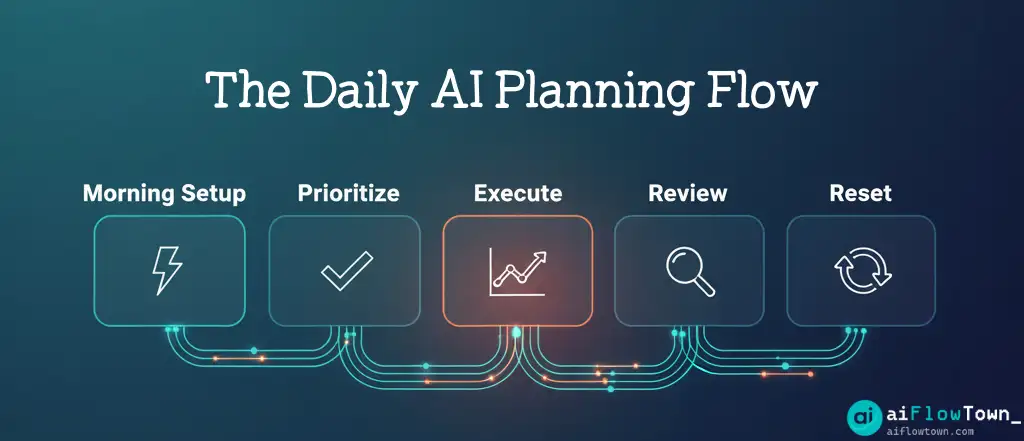
Prompt 8: The 90-Day Goal Framework
"Design my next 90 days:

Big goal: [What I want to achieve in 3 months]
Current obstacles: [What's blocking me]
Available time: [Hours per week I can dedicate]

Break into:
- Month 1: Foundation (what groundwork is needed?)
- Month 2: Momentum (where do I build on month 1?)
- Month 3: Completion (how do I finish strong?)

For each month:
- 3 key objectives
- Weekly milestones
- Success metrics
- What I'll stop doing to make time

Make this realistic for someone with a full-time job."
Prompt 9: The Habit-Goal Alignment
"Align daily habits with my goal:

Goal: [What I'm working toward]
Timeline: [By when]
Current habits: [What I do daily now]

Design habit system:
1. What daily habit would most directly support this goal?
2. How small can I make it to ensure I do it every day?
3. When/where will I do this habit? (be specific)
4. What existing habit can I stack it onto?
5. How will I track consistency?

Remember: tiny daily actions > occasional heroic efforts."
Prompt 10: The Goal Reality Check
"Pressure-test my goal:

My goal: [What I want to achieve]
Why I want it: [Motivation]
My plan: [How I think I'll achieve it]

Challenge my thinking:
1. Is this goal really mine, or someone else's expectation?
2. What am I assuming that might not be true?
3. What's the simplest way to achieve this (vs my complex plan)?
4. If I fail, what's the real cost?
5. Is there a smaller goal that would satisfy 80% of what I want?

Be brutally honest—save me from unrealistic goals."
Progress Tracking Prompts (11-15)
Prompt 11: The Weekly Review
"Review my week:

This week's plan: [What I intended to do]
What I actually did: [Reality]
Time estimates vs actual: [Where was I off?]

Analyze:
1. What worked well? (Do more of this)
2. What failed? (Why—be specific)
3. Where did I waste time?
4. What should I have said no to?
5. What surprised me?
6. Adjusted plan for next week based on learnings

Focus on patterns, not isolated incidents."
Prompt 12: The Progress Quantifier
"Measure progress toward goal:

Goal: [What I'm working on]
Started: [When I began]
Today's date: [Current date]
Milestones hit: [What I've completed]
Current status: [Where I am]

Calculate:
- Percentage complete (be objective)
- Pace: Am I on track, ahead, or behind?
- Projected completion date at current pace
- What needs to accelerate to meet deadline?
- Leading indicators: are my daily actions sufficient?

Give me numbers, not feelings."
Prompt 13: The Obstacle Identifier
"Find what's blocking my progress:

Goal: [What I'm trying to achieve]
Plan: [What I intended to do]
What's actually happening: [Reality vs plan]
Excuses I'm using: [Be honest]

Identify true obstacles:
1. External blockers (things outside my control)
2. Internal blockers (skills, knowledge, habits I lack)
3. Priority conflicts (competing demands)
4. Hidden resistance (am I self-sabotaging? why?)

For each blocker, suggest one concrete action to address it."
Prompt 14: The Momentum Maintainer
"I'm losing motivation. Help me maintain momentum:

Goal: [What I'm working toward]
Progress so far: [What I've done]
Why I'm stuck: [What feels hard now]
Original motivation: [Why I started]

Reignite momentum:
1. Wins I've had (even small ones) I'm forgetting to celebrate
2. Why this matters more than I'm admitting
3. What's the smallest next step I can take today?
4. Who can I tell about my goal for accountability?
5. What reward can I give myself for the next milestone?

Make this feel achievable again."
Prompt 15: The Pivot Evaluator
"Should I continue or pivot?

Original goal: [What I set out to do]
Time invested: [How long I've been working on it]
Results so far: [What I've achieved]
What's changed: [New information or circumstances]

Evaluate honestly:
1. Is lack of progress due to insufficient effort or wrong goal?
2. What would success look like from here?
3. Is doubling down smart or is this sunk cost fallacy?
4. If I pivoted, what would I do differently?
5. Decision: Continue, adjust, or abandon? Why?

Give me permission to quit if that's the smart move."
For more tracking strategies, visit templates and resources.
Evening Reflection Prompts (16-20)
Prompt 16: The Daily Wins Log
"Document today's progress:

Today's plan: [What I intended]
What I completed: [What actually happened]

Capture:
- 3 specific wins (even small ones)
- 1 thing I learned
- 1 thing that surprised me
- Tomorrow's #1 priority based on today
- What I'm grateful for about today

Focus on progress, not perfection. Build positive momentum."
Prompt 17: The Time Audit
"Analyze how I spent today:

Planned time blocks: [My schedule]
Actual time spent: [What really happened]
Unplanned items: [Interruptions, emergencies]

Calculate:
- Deep work hours: [Focused, valuable work]
- Shallow work hours: [Email, admin, meetings]
- Wasted hours: [Distractions, inefficiency]
- Time thieves: [What stole most time unexpectedly?]

What's one thing I should eliminate tomorrow?"
Prompt 18: The Energy Pattern Recognition
"Track my energy levels:

Morning energy (8am-12pm): [High/Medium/Low]
Afternoon energy (12pm-5pm): [High/Medium/Low]
Evening energy (5pm-9pm): [High/Medium/Low]

What affected energy:
- Sleep quality last night: [Scale 1-10]
- Meals and timing: [When and what I ate]
- Exercise: [Did I move?]
- Stress events: [What drained me?]

Identify patterns over 7 days to optimize scheduling."
Prompt 19: The Decision Review
"Review decisions I made today:

Key decisions: [What I chose to do or not do]
Time spent deciding: [How long I deliberated]

Evaluate:
1. Which decisions were good?
2. Which do I regret?
3. Which took too long for their importance?
4. What decision rules can I create to decide faster tomorrow?
5. What should I pre-decide to avoid decision fatigue?

Build decision frameworks for recurring choices."
Prompt 20: The Next Day Primer
"Prepare for tomorrow before I sleep:

Tomorrow's calendar: [Fixed commitments]
Unfinished from today: [Rollover tasks]
New tasks added: [What came in today]

Create tomorrow's plan:
- Most important task (the ONE thing)
- 3 supporting tasks (if time permits)
- Prep needed tonight (so I start fast tomorrow)
- Realistic time available (after meetings and buffer)
- What I'm saying NO to tomorrow

Make tomorrow's start effortless—no morning decision fatigue."
Using productivity planning prompts for professionals consistently builds planning muscle. For more prompts, check prompt library.
❓ FAQ
⏰ How long does AI planning take?
Morning planning: 5-7 minutes using 1-2 prompts. Evening review: 3-5 minutes using 1 prompt. Total: 10 minutes daily max. Far faster than manual planning, produces better plans. The prompts do the cognitive work you’d otherwise spend 20-30 minutes on.
Should I use all 20 prompts daily?
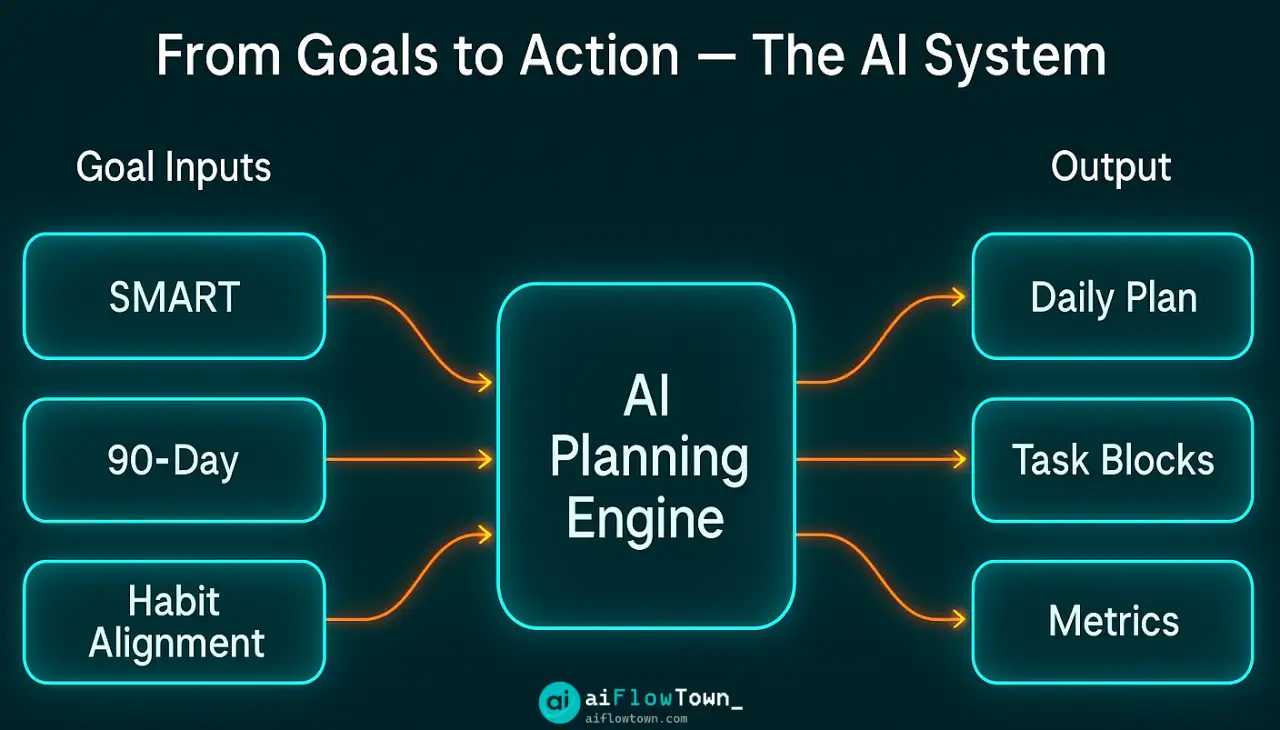
No. Pick 1-2 morning prompts for planning, 1 evening prompt for review. Rotate based on needs—use Progress Tracking prompts weekly, Goal Setting monthly. Using all 20 daily would make planning your full-time job. Choose what’s relevant for today.
Which prompts are most effective?
Most universal: Prompt #1 (Realistic Day Design), #2 (Priority Matrix), #16 (Daily Wins). These work for everyone regardless of goals or work type. Advanced users love #8 (90-Day Framework) and #13 (Obstacle Identifier) for deeper work.
How do I track if planning is helping?
Track weekly: Tasks completed vs planned, time wasted vs time estimates, progress toward goals. After 4 weeks, compare to pre-AI planning. Most see 30-40% increase in planned-to-completed ratio and clearer goal progress. If not improving, adjust prompts or execution.
What if AI plans don’t match reality?
Update prompts with your actual patterns. If AI consistently overestimates capacity, explicitly state “I historically complete 60% of planned tasks” in prompts. If energy patterns change, update them. Prompts improve with better input about your reality. Treat them as templates to customize.
Final Thoughts
These daily planning prompts transform planning from vague intention (“I should be productive”) to concrete execution (“At 9am, I’m working on X for 90 minutes”). The difference between successful people and busy people isn’t effort—it’s directing that effort intelligently.
Start this week with just two prompts: one morning planner and one evening reviewer. Use them daily for 5 days. You’ll notice patterns in what works, where you’re unrealistic, and how to adjust. After two weeks, planning becomes automatic—the prompts just help you think clearly using organize daily tasks using ai systematically.
Five minutes of structured planning using smart goal-setting prompts with ai saves hours of wandering. Your future self, accomplishing more with less stress, will thank you for implementing this planning system today.
Next: Combine these planning prompts with our guide to AI workflows for complete productivity systems that transform how you work.
⚠️ Reminder: Even the smartest tools / AI can miss small details or make mistakes. Always double-check your work before presenting or publishing it - a quick review can save hours later.