Reclaim Focus with AI-Powered Deep Work
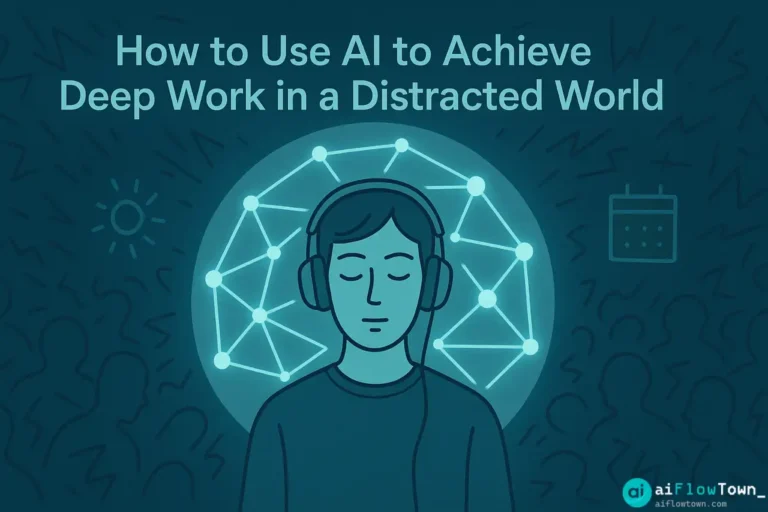
Our brains were never designed for constant interruption. Every notification, message, and “quick check” splits your attention — and it takes minutes to recover. The modern mind is permanently half-present, pulled between tabs, feeds, and deadlines. That’s why true focus feels almost mythical today. But what if technology could reverse that? What if the same systems distracting you could be retrained to defend your concentration? That’s the promise of AI deep work.
Understanding deep work through the AI lens
Deep work isn’t about isolation. It’s about structured attention — the ability to hold one meaningful problem long enough to make progress. AI helps by turning invisible distractions into visible data, then helping you act on them. You don’t need more willpower; you need systems that protect your focus.
“Focus is not about blocking the world out — it’s about designing a world that doesn’t need blocking.”
AI gives you that design layer. From scheduling your day to guiding your flow, it creates boundaries that hold.
You can explore more ready-to-use frameworks for this kind of structured focus inside our Prompt Library, where you’ll find collections built specifically for focus, reflection, and flow states.
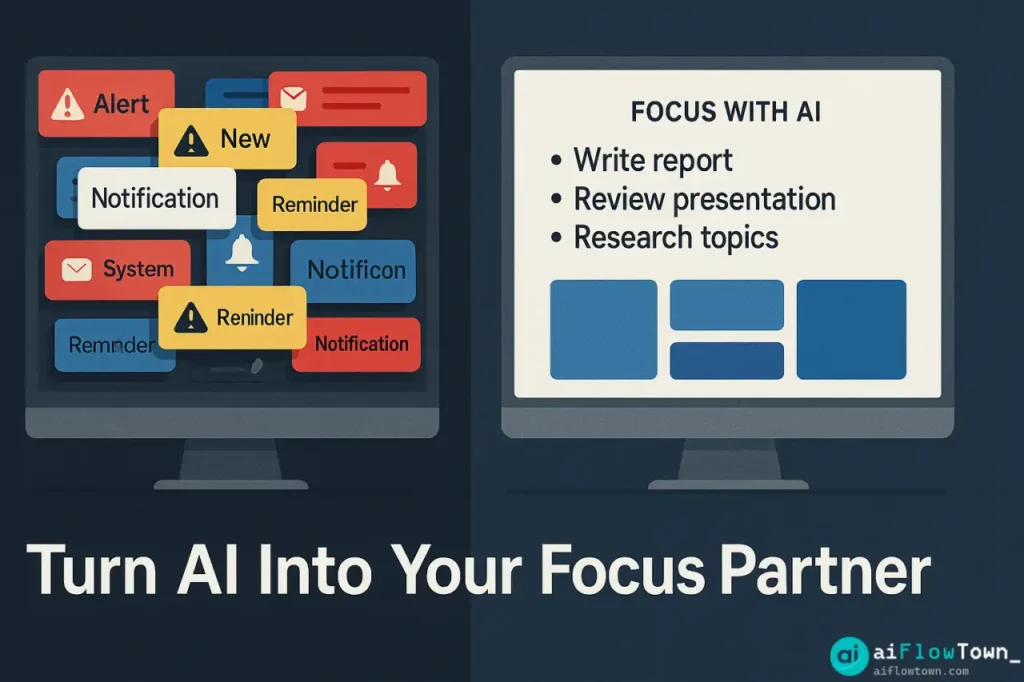
How AI helps rebuild your attention
Let’s be clear: AI doesn’t do deep work for you. It simply clears the path. It handles reminders, patterns, and prompts so your brain can stay where it performs best — in the zone.
1. AI as your focus mirror
AI tools can record, analyze, and reflect your daily behavior. Imagine asking, “How did I spend my focus hours this week?” and getting a pattern report showing when your attention spikes or drops. Tools like this make awareness measurable — the first step toward mastering AI tools for focus.
2. AI as your time architect
Time blocking used to mean manual calendars. Now, AI can create dynamic blocks based on your workload, energy, and habits. It learns when you perform best and rearranges tasks accordingly — a simple but powerful form of AI for time blocking.
3. AI as your planning assistant
Deep work requires clarity before immersion. You can use AI to break complex tasks into manageable steps, or to generate focus prompts. For example: “Create a 90-minute deep work plan to finish my draft with no interruptions.” That’s one of the many AI prompts for deep work you can adapt into your routine.
Building your AI-assisted deep work routine
Let’s turn the theory into practice. Here’s a practical framework you can follow to create your own “AI-supported focus system.”
| Step | AI Application |
|---|---|
| Define | Use AI to clarify the single problem you want to solve today. |
| Plan | Ask AI to structure your workday with energy-based time blocks. |
| Focus | Generate environmental reminders and focus scripts for your session. |
| Review | Summarize your progress using an AI journaling prompt. |
| Reflect | Analyze distractions and redesign tomorrow’s flow. |
Once this loop becomes natural, you’ll find that focus stops feeling forced. You won’t need to fight for deep work — it will become your default mode.
Example prompts for mastering AI deep work
Here are sample prompts you can try today. Adjust them to your role, tone, and goals:
- “Plan a 2-hour distraction-free work session with built-in breaks.”
- “Summarize my top 3 priorities for today in less than 50 words.”
- “Design a weekly deep work routine aligned with my peak hours.”
- “Analyze my calendar and find time leaks.”
- “Create a morning focus ritual with reflection checkpoints.”
To see how these can evolve into full workflows, visit our AI Workflows section — it shows how prompts connect to tools and automation to keep your attention on what truly matters.
The emotional side of focus
People often think productivity is mechanical, but it’s emotional first. Every distraction has a trigger — boredom, anxiety, or avoidance. AI can help you spot patterns in your journal or behavior logs, but self-awareness remains the core engine.
“The more you understand why you drift, the easier it becomes to stay.”
That’s where journaling or reflection prompts make a difference. They help you notice what drains energy and what restores it. Combine that insight with automation, and you’ll create a feedback loop that learns with you.
Choosing the right tools
Not every tool fits every workflow. The best AI setups are minimal, quiet, and responsive — not overloaded dashboards. Choose apps that nudge focus, not noise. Our Tools & Apps guide lists options curated for clarity, not clutter.
Principles for selection
- Automation should save cognitive effort, not add complexity.
- Dashboards should display only what you need for the next 3 hours.
- Every tool must reinforce one habit: return to focus.
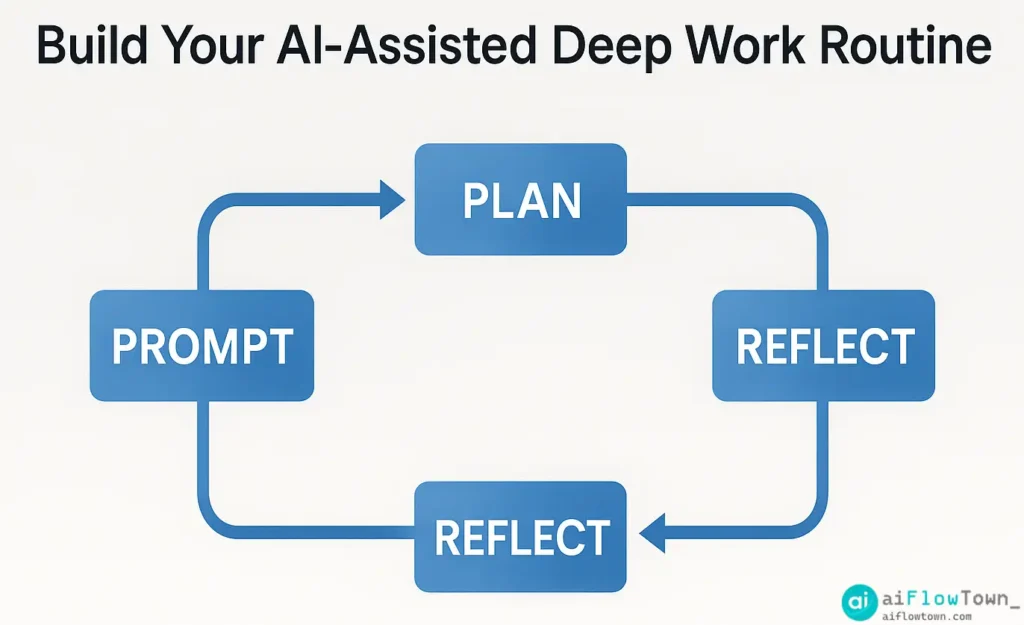
Integrating AI into deep work cycles
The key is rhythm. Instead of working endlessly, alternate between deep focus and deliberate recovery. Here’s a sample daily cycle built with AI and distraction management in mind:
| Phase | Duration | AI Support |
|---|---|---|
| Morning Planning | 30 min | Generate goals and priorities using focus prompts. |
| Deep Work Block | 90 min | Mute notifications, set focus reminders, track interruptions. |
| 15 min | Summarize what worked and what broke focus. | |
| Creative Exploration | 60 min | Use AI brainstorming for problem-solving. |
| Evening Reflection | 20 min | Analyze energy trends and write short insights. |
AI as an accountability system
Discipline grows stronger with visibility. When you use AI to track your focus logs, distraction patterns, and completion rates, you start to externalize accountability. The system becomes your silent coach — calm, consistent, and always ready to nudge you back into flow.
“AI doesn’t replace discipline — it helps you remember why it matters.”
– aiFlowTown –
When to disconnect
Ironically, one of the most powerful uses of AI is learning when to turn it off. Use it to plan rest, recovery, and silence. Deep work thrives in contrast: intense effort balanced with deliberate downtime. Protect both sides equally.
AI won’t focus for you — but it will focus with you
When people say AI boosts productivity, what they often mean is that it removes friction. The true magic happens when those freed-up minutes turn into moments of presence — writing with clarity, thinking deeply, or solving something that actually matters.
If you’re building your personal focus system or refining your prompt habits, revisit our AI Productivity Prompts pillar. It’s the foundation for using language itself as a productivity tool — and the perfect complement to deep work.
❓ FAQ
How long should a deep work session last?
Ideally between 60–120 minutes. Use AI timers or focus scripts to manage intervals naturally instead of forcing attention.
What AI apps are best for tracking focus?
Any that offer visual feedback loops and calm notifications. Simplicity beats feature overload.
Can AI help me overcome procrastination?
Yes — by breaking large, vague goals into concrete steps and nudging you to act one decision at a time.
Do I need to use multiple AI tools?
No. One or two tools integrated smoothly is far better than many competing systems. Focus on consistency.
Final thoughts
Deep work isn’t about escaping technology — it’s about mastering it. AI won’t eliminate distractions for you, but it can give you the structure, reflection, and rhythm to stay anchored in what truly matters. Use it as a compass, not a crutch.
And when the noise creeps back in, return to your system, refine your prompts, and remind yourself why you started. Because clarity is a practice — and with AI deep work, you’re finally training it every day.
⚠️ Reminder: Even the smartest tools / AI can miss small details or make mistakes. Always double-check your work before presenting or publishing it - a quick review can save hours later.