Marketing Prompts That Turn Blank Screens Into Strategy
In the world of marketing, the most intimidating challenge isn’t the competition; it’s the blank page. You don’t need another expensive writing app—you need sharper questions. Great marketing starts with the right input, and that’s exactly what these marketing prompts do. They provide the structure and stimulus to help you think, plan, and write like a seasoned copywriter, without waiting for inspiration to strike. Instead of staring at a blank screen, you’ll have a repeatable process. This guide provides over 50 prompts designed to push your creativity forward while keeping it focused on strategic goals. Whether you write ads, blogs, emails, or social posts, these prompts will help you turn a general-purpose tool like ChatGPT into your on-demand creative partner. This is how you learn how to write better ad copy and content across the board.
Why Prompts Matter More Than Tools
An AI is a powerful engine, but a prompt is the steering wheel. A vague question leads to a generic answer. A strategic question, however, can unlock profound insights and high-quality content. The prompts in this playbook are designed to be strategic. They are based on the same frameworks that professional copywriters and marketers use to develop campaigns that connect with audiences and drive action. By using these prompts, you’re not just getting text; you’re engaging in a structured creative process.
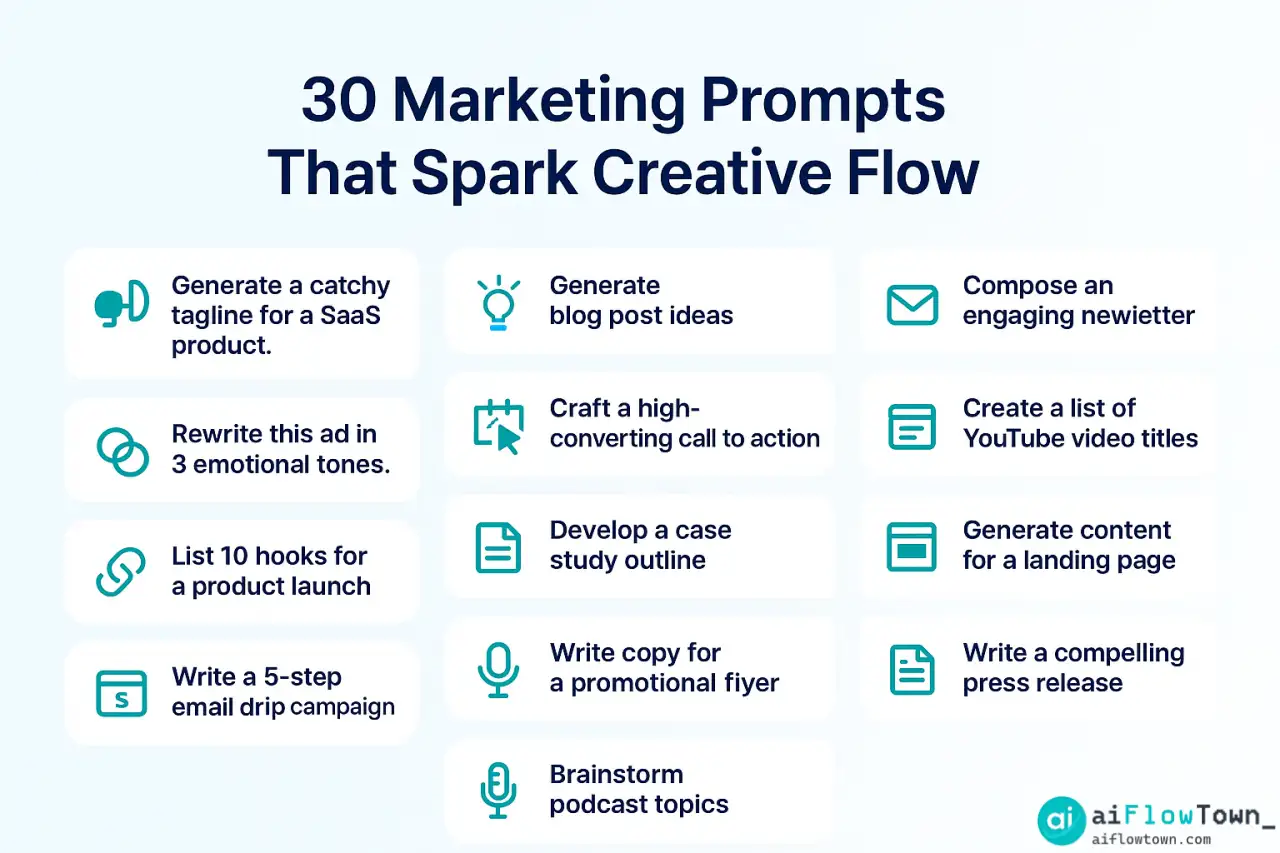
The Prompt Library: 50+ Prompts for Every Marketing Need
We’ve organized these prompts into key categories that follow a logical marketing workflow, from high-level brand strategy to detailed conversion copy. Each prompt is a mini-template—copy it, fill in your details, and watch the magic happen.
1. Brand Clarity & Voice Prompts
Before you write a single word of copy, you need to know who you are and who you’re talking to. These brand voice prompts establish your foundation.
- 1. Define Brand Voice:
Act as a senior brand strategist. Our company, [Your Company Name], helps [Target Audience] solve [Problem]. Our core values are [Value 1] and [Value 2]. Your task is to: 1. Define our brand voice using 3 distinct adjectives and 1 powerful metaphor. 2. Based on that definition, write a short paragraph (approx. 50 words) announcing a new product feature, ensuring the voice is perfectly captured. - 2. Summarize Brand Promise:
Summarize our brand's core promise for our product, [Product Name], into a single, powerful sentence under 12 words. - 3. Create a “Brand Voice & Tone” Guide:
Generate a mini "Brand Voice & Tone" guide in a markdown table. The columns should be 'Attribute', 'Description', and 'Example (Do/Don't)'. Include rows for our key voice attributes: [Adjective 1], [Adjective 2], and [Adjective 3]. - 4. Explain the Brand Simply:
Explain our brand and its primary product, [Product Name], to a 10-year-old. Now, explain it to a skeptical industry expert who has seen it all. - 5. Write the Brand Origin Story:
Write our brand's origin story in 100 words. Focus on the "why" behind what we do—the original problem we set out to solve for [Target Audience].
2. Hook & Headline Prompts
Headlines are the most critical part of your copy. They make or break campaigns. Use these to generate and test high-impact options.
- 6. Benefit + Curiosity Headlines:
Act as a world-class copywriter. Write 10 headlines for a blog post about [Topic] that combine a strong, tangible benefit with an element of curiosity. - 7. Viral Video Hooks:
Take this product description: "[Paste product description]". Your task is to turn it into 5 viral-style hooks for a short-form video (like a TikTok or Reel). Each hook must be under 15 words. - 8. Emotional Angle Headlines:
Rewrite this ad headline: "[Your Headline]". Create three new versions, each targeting a different primary emotion: - Version 1: Fear (Focus on FOMO or the pain of not using the product). - Version 2: Hope (Focus on the aspirational outcome or transformation). - Version 3: Curiosity (Ask a provocative question). - 9. Urgency/Scarcity Headlines:
Generate 5 headline variations for a landing page that emphasize urgency and scarcity for our offer, [Offer Details], without using cheesy phrases like "Act Now!". - 10. Competitor Analysis Angle:
Analyze the top 3 competitor headlines for the keyword "[keyword]" and suggest a unique, contrarian angle for our headline that will make it stand out.
3. Storytelling & Narrative Prompts
Facts tell, stories sell. These prompts help you build a compelling narrative around your product and brand.
- 11. Three-Act Story:
Turn the key benefit of our product, [Benefit], into a short, three-act story about a fictional customer named Alex. Act 1: The Problem. Act 2: The Discovery. Act 3: The Resolution. - 12. Before → After → Bridge Framework:
Write a customer success story using the "Before → After → Bridge" framework. Before they used our product, their problem was [Problem]. After, their result was [Result]. The bridge is how our product made that transformation possible. - 13. “Day in the Life” Scenario:
Describe a vivid "day in the life" of our ideal customer, [Customer Persona], before they discovered our solution. Focus on the specific, tangible pain points and frustrations they experience. - 14. Authentic Testimonial Draft:
Draft a customer testimonial that sounds authentic, specific, and emotionally resonant. It should mention a specific feature and a quantifiable result, not just generic praise. - 15. Mission-Driven Story:
Write a 150-word story that demonstrates our company's core mission, [Mission Statement], in action, without explicitly stating the mission itself.
4. Email Marketing Prompts
Email is still one of the highest-ROI marketing channels. These email marketing prompts will help you craft campaigns that get opened, read, and clicked.
- 16. Welcome Sequence Outline:
Act as an email marketing specialist. Outline a 5-email welcome sequence for new subscribers. The goal is to build trust and introduce our core offer. Provide a specific theme and call-to-action for each email. - 17. Re-engagement Campaign:
Write a 3-email "re-engagement" campaign to win back inactive subscribers who have not opened an email in 90 days. - Email 1: A simple, 2-sentence "break-up" style email. - Email 2: Offer them our most popular free resource, [Name of Resource]. - Email 3: A final notification that they will be removed from the list. Write the subject line and body copy for all three emails. - 18. Product Launch Email:
Craft a powerful launch email for a new product, [Product Name]. The email must include elements of social proof (e.g., a quote from a beta tester), urgency (e.g., a launch-day bonus), and a single, clear call-to-action. - 19. Post-Purchase “Thank You” Email:
Write a post-purchase "thank you" email that does more than just confirm the order. It should make the customer feel smart for their purchase, provide one unexpected tip on how to get started, and deepen their trust in our brand. - 20. Newsletter Teaser from Blog Post:
Take our latest blog post: "[Paste article text or link]". Summarize it into a short, engaging 200-word newsletter teaser designed to drive clicks to the full article. The teaser should use a curiosity hook and highlight the most valuable takeaway.
5. Social Media & Content Prompts
Generate engaging social media content ideas that sound human and spark conversation.
- 21. Contrarian Industry Tweets:
Write 5 tweet-style posts (under 280 characters) that challenge a common myth in our industry, [Industry Myth], and offer a controversial-but-true insight. - 22. Data-Driven LinkedIn Post:
Turn this data point: "[Insert surprising statistic about your industry]" into an engaging LinkedIn post. The post structure should be: Hook -> Explain the Data -> Imply the Stakes -> Ask a Question. - 23. Multi-Tone Instagram Captions:
Create 3 Instagram captions for an image of [describe image]. Each caption should have a different tone: one playful, one inspirational, and one educational. All must include a clear CTA and relevant hashtags. - 24. Video Script Hooks:
Generate 10 one-line hooks for a video script about [Topic]. Each hook should be designed to stop a user from scrolling in the first 3 seconds. - 25. Repurpose Content for Carousel:
Repurpose the key ideas from this blog post: "[Paste article text]". Turn them into a 5-slide script for an Instagram/LinkedIn carousel. Each slide should have a title and a short, punchy sentence.
6. SEO & Blog Prompts
Use these seo blog prompts to structure your thoughts, conduct keyword research, and write long-form content more efficiently.
- 26. Keyword Cluster Generation:
Act as an SEO expert. Our main topic is "[Topic]". Generate a list of related long-tail keywords and "People Also Ask" style user questions that we should cover in our article to achieve topical authority. - 27. Detailed Content Outline:
Create a detailed content outline for a 1,500-word blog post on "[Topic]". The outline must include SEO-friendly H2s and H3s, and be structured to directly address the primary search intent behind the keyword. - 28. Click-Worthy Meta Descriptions:
Write 3 different meta descriptions (under 155 characters) for an article with the title "[Article Title]". Each should have a different angle: one focused on benefit, one on curiosity, and one that includes a statistic. - 29. Compelling Introductions:
Write 5 different introductions for a blog post about [Topic], each using a different hook: a surprising statistic, a relatable story, a provocative question, a bold statement, and a historical fact. - 30. Paragraph from Bullet Points:
Take these messy bullet points from my research: "[Paste notes]". Turn them into a cohesive, well-written paragraph of about 150 words for an article, ensuring a smooth flow and clear narrative.
7. Conversion & Sales Prompts
Marketing without conversion is just a conversation. Use these prompts to write copy for landing pages, ads, and CTAs that drives action.
- 31. Creative CTA Buttons:
Write 5 call-to-action (CTA) button texts for our landing page that are more creative and compelling than "Submit" or "Learn More." The goal is to [Desired Action]. - 32. PAS Framework Copywriting:
Use the PAS (Problem-Agitate-Solve) framework to rewrite this landing page introduction: "[Paste intro text]". You can learn more about this classic framework from marketing experts like HubSpot. - 33. Feature-to-Benefit Translation:
Take this list of product features: "[Paste feature list]". Translate each feature into a clear, tangible customer benefit. Format the output as a two-column table: 'Feature' and 'What This Means For You'. - 34. High-CTR Email Subject Lines:
Write 3 different email subject lines for a sales promotion for [Product Name]. Each subject line must test a different psychological angle: urgency, curiosity, and direct benefit. - 35. Objection Handling Copy:
Explain why our product, [Product Name], is a better solution for [Pain Point] than the common alternatives. Proactively address the most common customer objection: "[Common Objection]".
Matching Prompts to Marketing Goals
Not sure which prompts to use? This table maps common marketing objectives to the most relevant prompt categories from our list.
| Marketing Goal | Primary Prompt Categories | Example Use Case |
|---|---|---|
| Brand Awareness | Brand Clarity, Storytelling, Social Media | Creating a consistent brand voice and sharing engaging stories on social platforms. |
| Lead Generation | SEO & Blog, Hook & Headline, Email Marketing | Writing a high-value blog post with a compelling headline to capture email sign-ups. |
| Sales & Conversion | Conversion & Sales, Storytelling, Email Marketing | Crafting a high-converting landing page and a follow-up email sequence. |
| Customer Engagement | Social Media, Email Marketing, Storytelling | Writing engaging social posts and newsletters that build a loyal community. |
How to Use These Prompts Effectively
Don’t just copy and paste. The best results come from treating these prompts as starting points. Here’s a simple workflow:
- Pick a Goal: Decide what you need to write (e.g., a LinkedIn post).
- Choose a Prompt: Select a relevant prompt from the list (e.g., from the Social Media category).
- Add Context: Before you paste the prompt, give the AI context. “Act as a B2B marketing expert. Our target audience is CMOs. Our brand voice is authoritative and insightful. Now, [paste the prompt here].”
- Iterate and Refine: Use the first output as a draft. Follow up with refinement prompts like, “Make this shorter,” or “Rewrite this in a more confident tone.”
The skill is not in the first prompt, but in the follow-up conversation. For more on this, explore our guide to AI productivity prompts.
Conclusion: From Blank Page to Strategic Campaign
Writing isn’t about mysterious talent anymore—it’s about having a repeatable process. With the right marketing prompts, anyone can write sharper headlines, clearer copy, and more effective campaigns. The skill is no longer about writing from scratch, but about asking smarter questions.
Start small. Pick one category that addresses your biggest bottleneck. Save the outputs that work. Refine them weekly. In a month, your writing will not only be faster, but it will be more strategic, professional, and effective—because you’ll be thinking like a copywriter who never runs out of ideas.
❓ FAQ
How do I get better results from these marketing prompts?
Add context before the prompt. Always tell the AI your target audience, your product/service, and the desired tone of voice. The more detail you provide upfront, the more tailored and effective the output will be.
✏️ Can I use these copywriting prompts for any industry?
Absolutely. The frameworks behind these prompts (e.g., storytelling, problem-agitate-solve) are universal. Simply adapt the specifics (product, audience, tone) to match your industry, whether it’s tech, fashion, SaaS, or professional services.
What’s the best way to organize my favorite prompts?
Create a simple table or database in Notion. Have columns for “Purpose” (e.g., “Email Subject Line”), “Prompt Template,” and “Example Output.” Over time, you’ll build a personal AI playbook that is perfectly tuned to your brand’s voice. You can even start with one of the free Notion templates available online.
Do professional marketers actually use ChatGPT this way?
Yes, constantly. Agencies and in-house teams use structured prompt systems to accelerate brainstorming, outline content, overcome writer’s block, and refine copy much faster. It’s not about replacing the marketer; it’s about augmenting their creative process and ensuring consistency.
⚠️ Reminder: Even the smartest tools / AI can miss small details or make mistakes. Always double-check your work before presenting or publishing it - a quick review can save hours later.