The Vague Feedback Problem
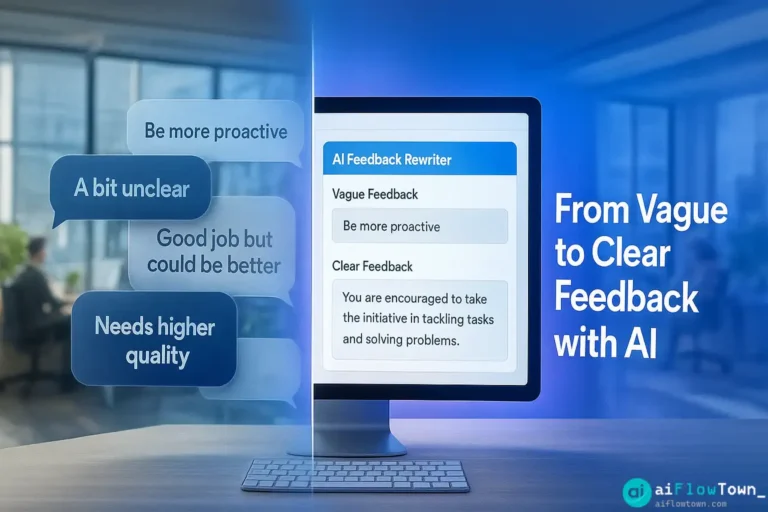
You know someone needs to improve, but articulating exactly what and how is difficult. Your brain processes impressions (“they’re not quite getting it”) faster than it can identify specific behaviors. So feedback comes out vague: “be more detail-oriented,” “improve communication,” “show more initiative.” These phrases feel meaningful to you because you have context. To the receiver, they’re abstract concepts without clear action items.
Common vague feedback patterns:
- ⚠️ “Great work!” (what specifically was great?)
- ⚠️ “This needs improvement” (which parts, improved how?)
- ⚠️ “Be more professional” (what behaviors to change?)
- ⚠️ “Take more ownership” (what does ownership look like?)
- ⚠️ “Communication could be better” (written? verbal? frequency? clarity?)
Using ai feedback writing prompts doesn’t replace your judgment about what needs to change—it helps you articulate that judgment clearly using how to write clear feedback with ai systematically. For more communication strategies, visit AI productivity prompts.
The Feedback Transformation Prompt
Take your vague initial thoughts and transform them into actionable feedback:
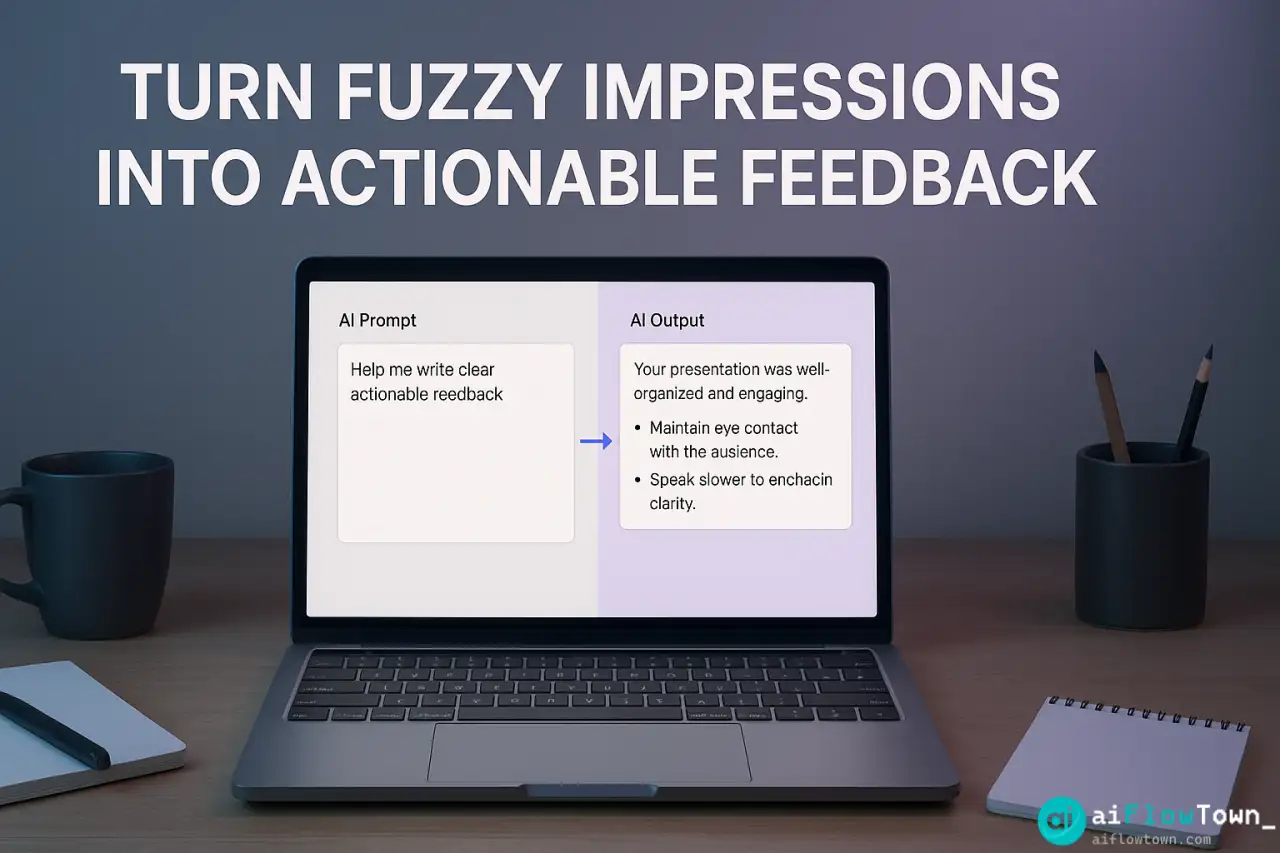
"Help me write clear, actionable feedback.

My vague impression:
[Write what you're thinking: "They need to be more detail-oriented" or "Communication could improve"]

Specific examples I've noticed:
[List 2-3 concrete instances where the issue showed up]
- Example 1: [What happened, when, impact]
- Example 2: [Another specific instance]
- Example 3: [One more if available]

Context about the person:
- Role: [Their job title/responsibilities]
- Experience level: [Junior/Mid/Senior]
- Our relationship: [Manager/Peer/Stakeholder]
- Their strengths: [What they do well]

What I want to see change:
[The outcome you want—what would "success" look like?]

Transform this into feedback that:
1. References specific behaviors, not personality traits
2. Explains impact of current behavior (why it matters)
3. Provides 2-3 concrete actions they can take
4. Acknowledges their strengths (if positive feedback exists)
5. Sets clear expectations for what "improved" looks like

Tone: [Supportive/Direct/Encouraging - choose based on situation]
Length: 150-250 words - enough detail to be clear, concise enough to be memorable"
This structured approach ensures create constructive feedback using chatgpt that people can actually act on. Learn more at AI workflow examples.
Before and After Examples
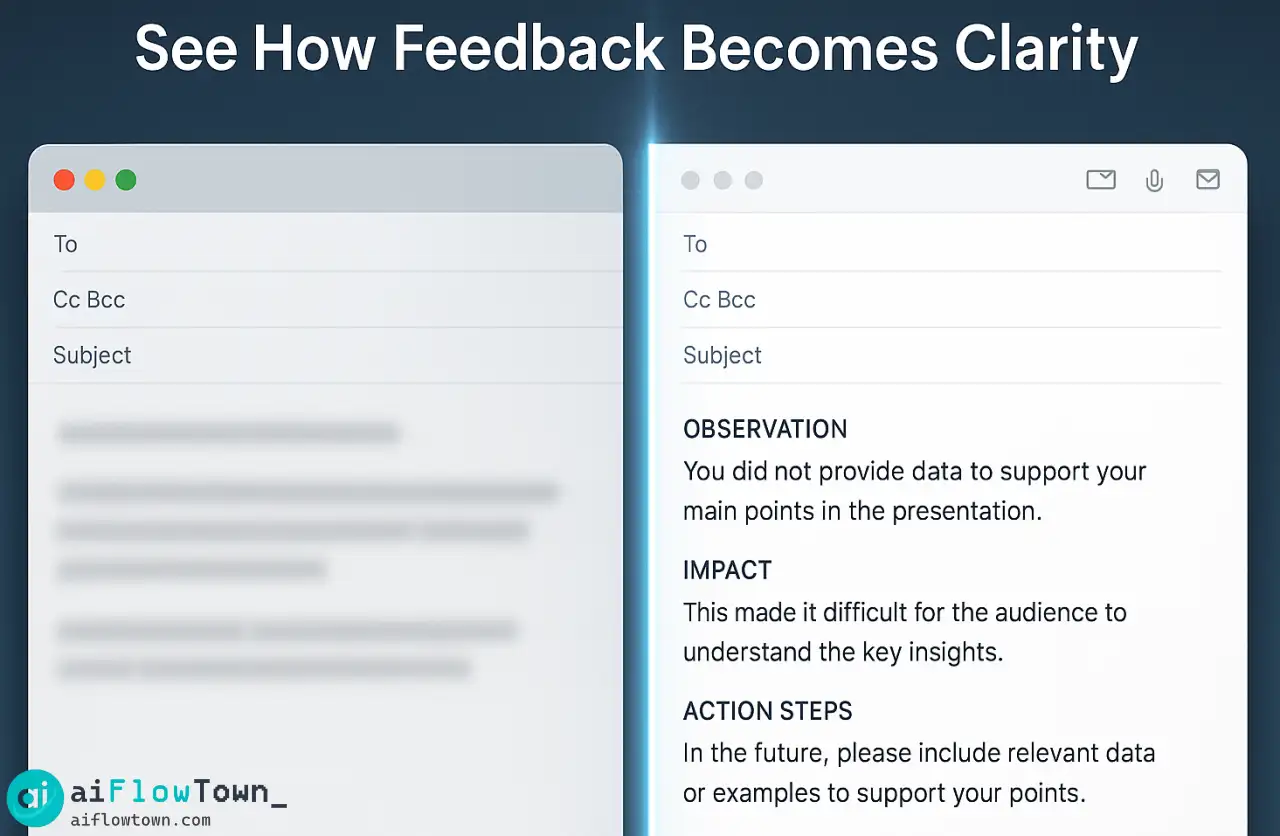
Example 1: Project Management Feedback
Vague version (what you might write initially):
“You need to be more proactive in managing projects. Try to anticipate issues before they become problems. Also work on communication with stakeholders.”
Problems: “More proactive” and “anticipate issues” are abstract. “Work on communication” doesn’t specify what’s wrong or how to fix it.
AI-refined version:
I want to discuss project management approach. In the Q3 website redesign, we discovered the hosting requirements issue two days before launch, causing delays. Similarly, in the mobile app project, stakeholders weren’t updated for three weeks and were surprised by the timeline extension.
I’d like to see you implement weekly project reviews where you specifically ask: “What could go wrong this week?” and “Does everyone have what they need?” For stakeholder communication, send brief Monday updates even when there’s no major news—a two-sentence “still on track” email prevents surprise.
Your technical execution is strong—projects you deliver work well. These process changes will ensure your strong work gets delivered smoothly without last-minute surprises.
– Specific Actionable Feedback –
Better because: Cites specific examples, provides concrete actions (weekly reviews, Monday updates), acknowledges strengths, explains the “why” using write specific performance reviews with ai help effectively.
Example 2: Code Review Feedback
Vague version:
“Code quality needs improvement. Be more careful with edge cases and documentation.”
AI-refined version:
Looking at your recent pull requests, I’ve noticed two specific patterns. In PR #234, the input validation didn’t handle null values, which broke the API for users with incomplete profiles. In PR #256, there were no inline comments explaining the complex algorithm logic.
Before submitting PRs, please: (1) Test with null, empty, and extreme values for all inputs, (2) Add comments for any logic that takes more than 30 seconds to understand, (3) Include a brief “testing done” section in PR description.
Your code is efficient and well-structured—these additions will make it robust and maintainable too.
– Technical Feedback Done Right –
Better because: References actual PRs, provides checklist of actions, maintains encouraging tone while being direct using improve feedback quality using ai prompts systematically. For more examples, check productivity flow hacks.
Tone Calibration
Adjusting for Different Situations
| Situation | Tone Modifier | Language Pattern |
|---|---|---|
| First-time feedback | Encouraging, developmental | “I want to help you develop…” “Here’s what I notice…” |
| Repeated issue | Direct, with clear stakes | “We discussed this before…” “This needs to change because…” |
| High performer | Aspirational, growth-focused | “To get to next level…” “One thing holding you back…” |
| Struggling performer | Supportive but honest | “I’m concerned about…” “Let’s work together to…” |
| Peer feedback | Collaborative, humble | “Something I noticed…” “Would it help if…” |
Tone Prompt Additions
Modify the base prompt with these additions:
For encouraging tone:
"Frame as growth opportunity. Emphasize potential. Start with strength acknowledgment."

For direct tone:
"Be clear about seriousness. Use 'need to' not 'could consider.' Explain business impact."

For collaborative tone:
"Use 'we' language. Ask questions. Suggest partnering on solution."

For corrective tone:
"Reference previous discussions. State clear expectations. Include consequences if unchanged."
This ensures transform vague feedback into actionable guidance with appropriate emotional calibration.
Positive Feedback That Actually Motivates
Positive feedback gets vague too: “Great job!” AI helps make praise specific and meaningful:
"Help me write specific positive feedback.

What they did well: [General impression - "handled client call really well"]

Specific examples:
- [What exactly they said or did]
- [Impact it had]
- [What it demonstrated about their skills]

Write feedback that:
1. Describes the specific behavior or action
2. Explains why it was valuable (business impact)
3. Identifies the skill or quality it demonstrates
4. Encourages repeating this behavior

Avoid generic praise—make them understand exactly what to keep doing."
Example Output
In yesterday’s client call when the client raised concerns about timeline, you responded by: (1) acknowledging their concern without getting defensive, (2) walking through the current progress with specific milestones, (3) offering two alternative approaches with tradeoffs clearly explained.
This de-escalated what could have become a tense situation into a productive problem-solving conversation. The client left confident we understand their needs. Your ability to stay calm under pressure and translate technical constraints into business language is exactly what this account needs.
Keep using this approach—thoughtful, transparent communication builds trust that survives project challenges.
– Meaningful Praise –
Specific positive feedback reinforces good behavior more effectively than “great job!”
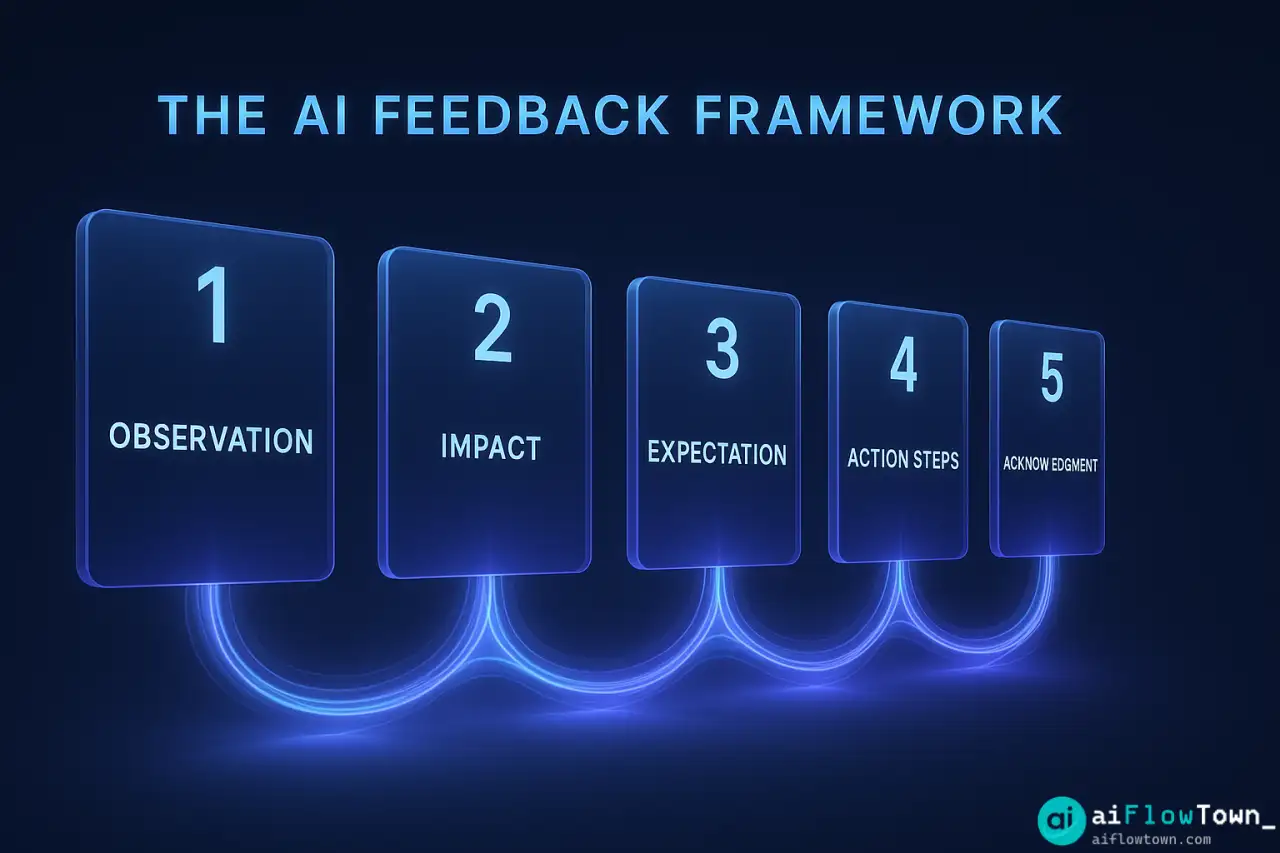
The Complete Feedback Template
Structure all feedback consistently:
OBSERVATION (What happened)
[1-2 specific examples of the behavior or work]

IMPACT (Why it matters)
[How this affected team/project/customers/results]

EXPECTATION (What success looks like)
[Clear description of desired future behavior]

ACTION STEPS (How to get there)
- [Specific action 1]
- [Specific action 2]
- [Specific action 3]

SUPPORT (What you'll provide)
[Resources, training, your availability to help]

ACKNOWLEDGMENT (What they're doing well)
[Relevant strength to maintain balance]

NEXT CHECK-IN (When we'll revisit)
[Specific date/timeline for follow-up]
Common Feedback Pitfalls AI Helps Avoid
The Feedback Sandwich (Done Wrong)
Traditional: positive → negative → positive. Problem: the negative gets lost.
AI-recommended approach:
Lead with what you observed (neutral), explain impact (factual), provide clear next steps (actionable), acknowledge strengths relevant to the issue (balanced). No artificial sandwich—just clear, complete feedback.
Personality vs Behavior
Ask AI to check your feedback:
"Review this feedback. Flag anywhere I'm commenting on personality traits rather than observable behaviors. Suggest behavior-focused alternatives."

❌ "You're not a team player"
✅ "In the last three team meetings, you've worked on your laptop instead of participating in discussions"

❌ "You have a bad attitude"
✅ "When I asked about the project delay, your response was 'it's not my problem to solve'"
Solution Prescription vs Collaborative Problem-Solving
Instead of: “You need to send weekly updates”
Try: “Stakeholders are missing visibility into progress. What communication approach would work with your workflow? Weekly email? Shared doc? Quick Slack updates?”
AI can help reframe prescriptive feedback as collaborative:
"Rewrite this feedback to invite the person's input on solutions rather than prescribing the fix."
❓ FAQ
⚡ Should I share that I used AI to write feedback?
No need. AI helped you articulate your thoughts clearly—the observations and expectations are yours. It’s like using spell-check: the content is yours, the tool just improved the delivery. Focus on the conversation, not the writing process.
Can AI write the entire feedback for me?
AI needs your specific examples and context. It structures and clarifies, but you provide the substance. If you skip the examples and just say “they need to improve,” AI will generate generic feedback that won’t help. Garbage in, garbage out.
What if the person gets defensive?
Clear feedback reduces defensiveness by focusing on behaviors not character. If they’re still defensive, that’s about them processing feedback, not your delivery. Give them time to absorb, schedule follow-up, stay open to their perspective.
⏰ How long should feedback take to deliver?
5-15 minutes for routine feedback. If it takes longer, you’re either under-prepared (gather examples first) or the issue is bigger than feedback alone can solve (might need coaching or performance improvement plan).
Should I document all feedback I give?
Yes for anything performance-related or repeated. Send email summary after verbal conversation: “Following our discussion, here’s what we agreed…” Creates shared record and confirms understanding. Use AI to generate the summary from your conversation notes.
Final Thoughts
Feedback only works when it’s clear enough to act on. AI feedback writing transforms vague impressions into specific, behavioral guidance that people can actually use to improve. The AI doesn’t decide what feedback to give—you do that based on your observations and judgment. It just helps you communicate that feedback in ways that land effectively.
Next time you need to give feedback, spend 5 minutes with AI transforming your initial thoughts into structured, specific guidance. The conversation will be clearer, the person will know exactly what to do differently, and you’ll see actual behavior change instead of confused nodding.
Vague feedback wastes everyone’s time. Clear feedback changes performance. AI helps you give the clear version.
⚠️ Reminder: Even the smartest tools / AI can miss small details or make mistakes. Always double-check your work before presenting or publishing it - a quick review can save hours later.