Introduction
Staring at a blank page waiting for inspiration is exhausting. Your brain circles the same tired ideas while deadlines loom. AI changes the game. These 20 brainstorming prompts push you past obvious answers and into territory you wouldn’t reach alone. Copy them, adapt them, and watch ideas flow.
Why AI Makes Brainstorming Better
Traditional brainstorming has limits. You’re constrained by your experience, biases, and mental patterns. You keep returning to familiar territory because that’s where your brain feels safe.
AI breaks those patterns. It suggests angles you’d never consider, combines concepts in unexpected ways, and generates volume without judgment. The best brainstorming prompts don’t replace your thinking—they amplify it by giving you raw material to refine.
How to Use These Prompts Effectively
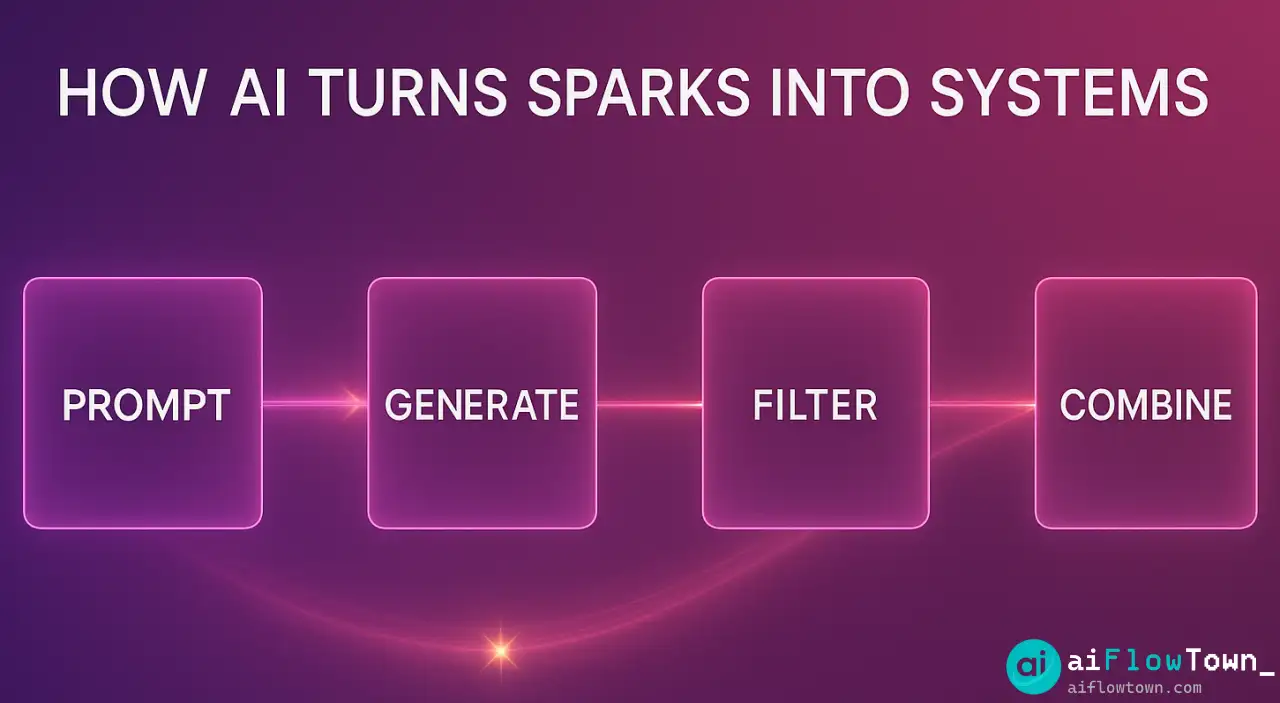
Don’t expect perfect ideas from first outputs. AI brainstorming is about quantity first, quality second. Generate 20 rough ideas, then refine the 3 most promising.
Combine multiple prompts for deeper exploration. Use one prompt to generate concepts, another to challenge assumptions, a third to identify gaps.
Customize every prompt with your specific context. Replace “[topic]” with your actual project, “[audience]” with real people, “[constraint]” with your actual limitations.
For more prompt strategies, explore our AI productivity prompts guide.
Divergent Thinking Prompts
1. The Opposite Prompt
**Prompt:**
I'm working on [topic]. List 10 ideas that are the exact opposite of conventional wisdom in this space. Challenge every assumption.

**Example:**
I'm working on productivity tools. List 10 ideas that are the exact opposite of conventional wisdom in this space. Challenge every assumption.
2. Random Connection Prompt
**Prompt:**
Combine [your topic] with these unrelated concepts: [concept 1], [concept 2], [concept 3]. Generate 5 unexpected ideas from each combination.

**Example:**
Combine email management with: medieval castles, jazz music, gardening. Generate 5 unexpected ideas from each combination.
3. The “What If” Cascade
**Prompt:**
Starting with [your challenge], generate a chain of "what if" questions. Each question should build on the previous answer. Go 10 levels deep.

**Example:**
Starting with "low customer engagement," generate a chain of "what if" questions. Each question should build on the previous answer. Go 10 levels deep.
4. Constraint Removal
**Prompt:**
I'm limited by [constraint 1], [constraint 2], [constraint 3]. Generate 10 ideas assuming these constraints don't exist. Then suggest ways to work around them.
5. Future Backward Planning
**Prompt:**
It's 5 years from now and [your goal] succeeded beyond expectations. Work backwards: what had to happen each year for this to be true? List the key decisions and breakthroughs.
Problem-Solving Prompts
6. The Five Whys Deep Dive
**Prompt:**
Problem: [describe problem]
Ask "why" five times, going deeper with each answer. Then generate 3 solutions for each level of "why."
7. Stakeholder Perspective Shift
**Prompt:**
View [your challenge] from these perspectives: a 10-year-old, a skeptical investor, a competitor, and your ideal customer. What would each see that you're missing?
8. Worst Possible Idea
**Prompt:**
Generate 10 intentionally terrible ideas for [your topic]. Then explain why each might actually contain a useful insight if refined.
9. Resource Remix
**Prompt:**
I have: [resource 1], [resource 2], [resource 3]. Generate 15 ways to combine these resources to solve [problem] that I haven't considered.
10. Analogical Thinking
**Prompt:**
How do these industries solve similar problems: [industry 1], [industry 2], [industry 3]? Adapt their solutions to [your challenge].

**Example:**
How do these industries solve customer onboarding: video games, theme parks, airlines? Adapt their solutions to SaaS onboarding.
Creative Expansion Prompts
11. The Mashup Generator
**Prompt:**
Take [successful product/service A] and [successful product/service B]. Generate 10 hybrid concepts that combine their best features for [your target audience].
12. Trends Intersection
**Prompt:**
These trends are emerging: [trend 1], [trend 2], [trend 3]. Where do they intersect? What opportunities exist at those intersection points?
13. Scale Shifting
**Prompt:**
Take [your idea] and reimagine it at: 10x smaller scale, 10x larger scale, and with 10x faster timeline. What changes at each scale?
14. Format Transformation
**Prompt:**
I want to communicate [message] to [audience]. Generate 10 radically different formats: podcast, game, physical object, experience, ritual, etc.
15. Customer Pain Point Mining
**Prompt:**
[Target audience] struggles with [problem]. List 20 specific moments of frustration they experience. Generate 3 solution ideas for each moment.
For more ways to use AI in your creative process, check out our AI workflows collection.
Evaluation and Refinement Prompts
16. Idea Stress Test
**Prompt:**
Here's my idea: [describe idea]. Attack it from every angle. What could go wrong? Who would hate it? What am I not seeing? Be brutally honest.
17. Feasibility Reality Check
**Prompt:**
Evaluate these ideas: [list ideas]. For each, assess: technical feasibility (1-10), market demand (1-10), resource requirements, timeline, and biggest risk.
18. Gap Analysis
**Prompt:**
In [your industry/space], what problems are unsolved? What needs are unmet? What complaints do people have? Generate a prioritized list of gaps.
19. Competitive Differentiation
**Prompt:**
Competitors in [space] all do [common approach]. Generate 10 ways to approach the same problem differently. Focus on what they're NOT doing.
20. Synthesis and Evolution
**Prompt:**
I've brainstormed these rough ideas: [list ideas]. Combine the best elements from multiple ideas. Create 5 evolved concepts that are stronger than any single idea.
Brainstorming Session Structure
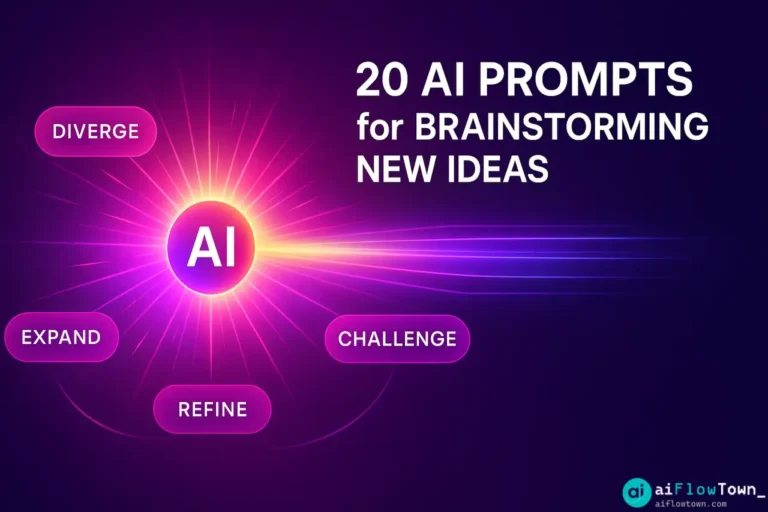
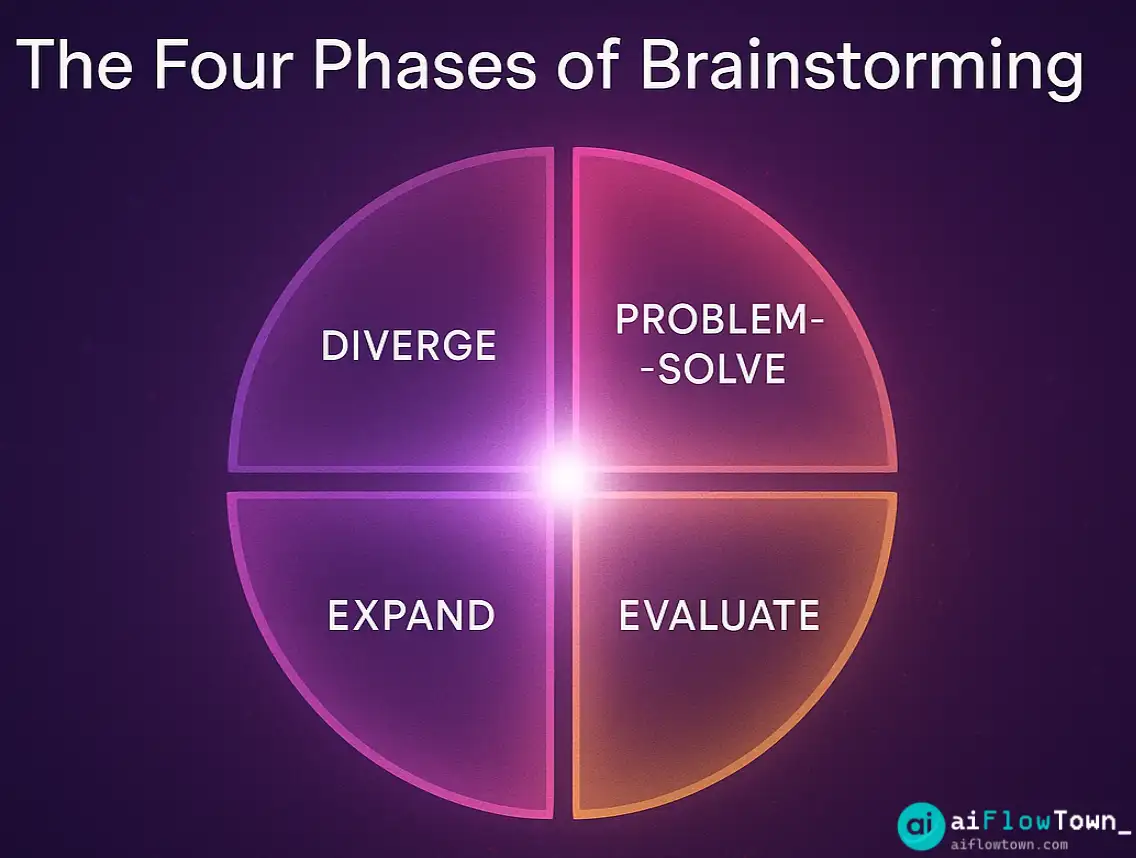
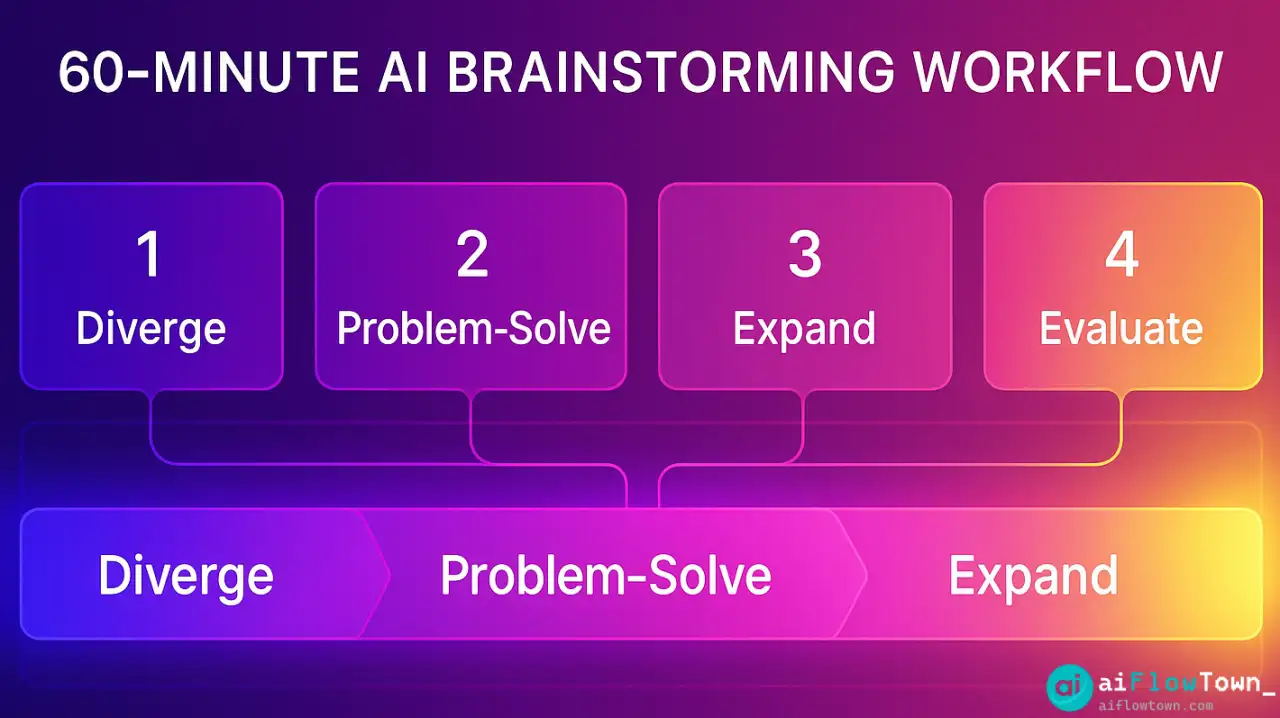
| Phase | Prompts to Use | Time | Goal |
|---|---|---|---|
| Diverge | 1, 2, 3, 4, 5 | 15 min | Generate volume, explore wide |
| Problem-Solve | 6, 7, 8, 9, 10 | 15 min | Address specific challenges |
| Expand | 11, 12, 13, 14, 15 | 15 min | Build on promising concepts |
| Evaluate | 16, 17, 18, 19, 20 | 15 min | Refine and prioritize |
Total brainstorming time: 60 minutes. Output: 50-100 raw ideas, narrowed to 5-10 strong concepts.
Tips for Better Brainstorming with AI
Set a volume target. Aim for quantity over quality in the first round. Tell AI: “Give me 50 ideas” instead of “Give me good ideas.”
Use follow-up prompts. When AI generates something interesting, dive deeper: “Expand on idea #7” or “What are 10 variations of this concept?”
Mix constraint and freedom. Start with constrained prompts (specific format, audience, budget). Then remove constraints to see what opens up.
Document everything. Save all outputs, even the wild ones. Today’s crazy idea might be next year’s breakthrough.
For more creative workflows, explore our prompt library for additional techniques.
Common Brainstorming Mistakes
Judging too early. Don’t critique during generation. Let AI produce volume first, evaluate later.
Being too vague. “Give me ideas” produces generic output. “Give me 10 mobile app ideas for busy parents managing kids’ schedules” produces useful output.
Stopping at first results. The best ideas often appear after 20-30 iterations. Push through obvious territory.
Ignoring “bad” ideas. Sometimes the worst idea contains a kernel of insight. Ask AI: “What’s useful about this terrible idea?”
❓ FAQ
How many ideas should I generate before evaluating?
Aim for at least 30-50 raw ideas before judging. Volume unlocks creativity. The best concepts often appear after you’ve exhausted obvious options.
⏱️ How long should a brainstorming session take?
45-60 minutes for a focused session. Longer than that and quality drops. If you need more, take a break and come back with fresh perspective.
Can I use these prompts for team brainstorming?
Absolutely. Run prompts individually first, then share outputs with the team. Use AI to prime the pump before group discussion. It makes meetings more productive.
What if AI’s ideas are too generic?
Add more context to your prompts. Include specific constraints, audience details, industry terminology, and examples. The more specific your input, the more useful the output.
How do I move from ideas to action?
After brainstorming, use evaluation prompts (#16-20) to assess feasibility. Pick 1-3 top ideas and create quick prototypes or tests. Action beats perfect planning.
Final Thoughts
The best brainstorming prompts don’t give you answers—they give you better questions. They push your thinking into uncomfortable territory where real innovation lives.
Don’t use AI to replace your creativity. Use it to unlock creativity you didn’t know you had. Let AI generate the raw material, then apply your judgment, experience, and intuition to refine it into something valuable.
Start with 5 prompts from this list. Run a 30-minute session. See what emerges. The goal isn’t to find the perfect idea immediately—it’s to train your brain to think differently.
Ready to build a complete creative system? Discover how brainstorming fits into your workflow with our guide to the 15 best AI productivity tools that amplify creative thinking.
⚠️ Reminder: Even the smartest tools / AI can miss small details or make mistakes. Always double-check your work before presenting or publishing it - a quick review can save hours later.