Start Strong with a Free Prompt Pack
Most people open ChatGPT and freeze at the blank box. That’s the same feeling copywriters get before a headline or students feel before an essay. The truth is: creativity needs a starting line. A free prompt pack gives you that — structured, proven openings that lead AI straight to useful answers.
Instead of reinventing every time, you pick the right prompt, drop it in, and let AI adapt to your context. That’s how professionals work smarter, not harder.
What Makes These 100 Prompt Packs Different
These aren’t random questions. Every prompt was tested across real-world workflows — writing, research, management, and learning. Each pack includes variations, tones, and follow-up instructions so you can scale one idea into many outputs. Think of it as your creative Swiss Army knife.
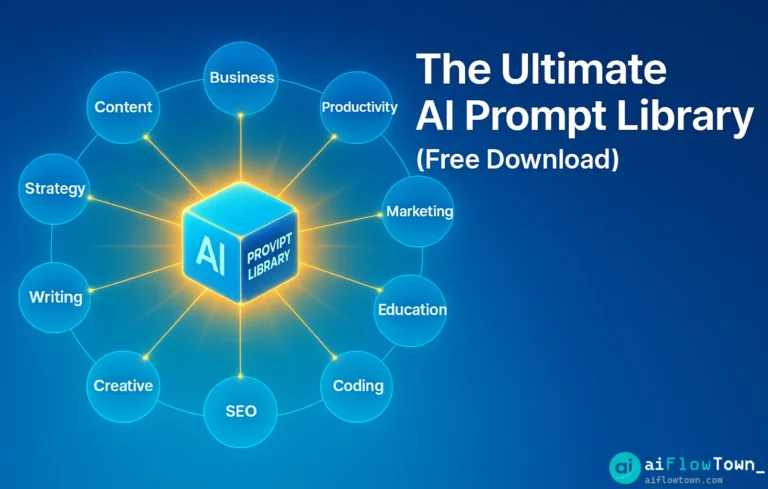
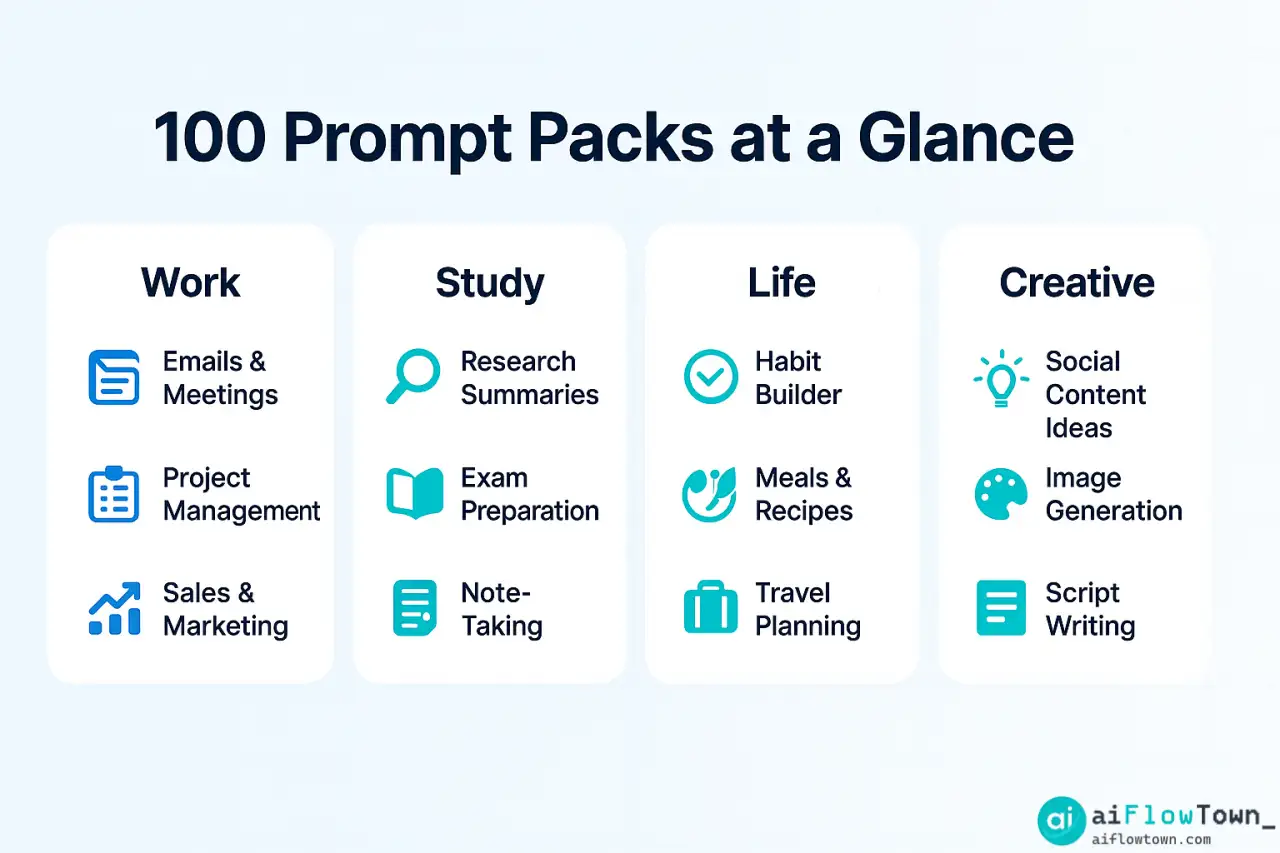
Four Categories of Prompt Packs
- ✅ Work — productivity, writing, communication, and automation.
- ✅ Study — note-taking, exam prep, concept summaries.
- ✅ Life — journaling, habits, reflection, and planning.
- ✅ Creative — idea generation, storytelling, and design thinking.
Work Prompt Packs: For Smarter, Faster Days
Email & Meeting Prompts
AI can handle your inbox without killing your tone. Try:
“Draft a friendly follow-up email confirming next steps after a client meeting.”
Save time by creating a preset macro inside your browser — one click, perfect draft.
Project & Task Management Prompts
These prompts pair perfectly with the automations from AI Automation Tools for Beginners. Let AI create structure before you open Notion or Asana:
- ✅ “Convert these notes into actionable tasks with deadlines.”
- ✅ “Summarize this project update for a team stand-up.”
- ✅ “Create a checklist for launching a new product.”
Marketing & Writing Prompts
For marketers, these packs are like instant inspiration. Combine them with techniques from AI Productivity Prompts to refine tone and message:
- ✅ “Write 3 headline variations emphasizing emotion, curiosity, and clarity.”
- ✅ “Create an ad copy that feels human, not robotic.”
- ✅ “List 10 hooks for a 15-second video intro.”
The Full Prompt Pack Library (100 Free Prompts)
This is your complete free prompt pack — 100 ready-to-use ideas for writing, learning, planning, and creating. Each one was tested to spark action and save time. Copy, adapt, and build your own AI workflow from them.
Work Prompts (25)
- 1. Follow-up Email:
Write a polite follow-up email after a client meeting regarding [Topic]. Include confirmation of [Key Decision] and outline the next steps: [Step 1], [Step 2].
- 2. Summarize Thread:
Summarize this long Slack thread/email chain: [Paste Thread Text]. Extract the 3 key decisions made and any outstanding action items.
- 3. Task List to Timeline:
Turn this task list: [Paste Task List] into a simple project timeline with estimated durations and key milestones for the [Project Name] project.
- 4. Rewrite for Executives:
Rewrite this internal update: [Paste Update Text] for an executive audience. Focus on clarity, brevity, and key results.
- 5. Draft Status Report:
Draft a quick status report based on this checklist of completed items and remaining tasks: [Paste Checklist]. Highlight progress and any blockers.
- 6. Meeting Agenda Creation:
Create a 60-minute meeting agenda for [Meeting Purpose]. Include time blocks, specific discussion topics, desired outcomes for each topic, and assigned speakers.
- 7. Headline Variations:
Generate 5 alternate headlines for this product announcement: "[Original Headline]". Focus on different angles like benefit, curiosity, or urgency.
- 8. Summarize Customer Feedback:
Summarize the following customer feedback: [Paste Feedback Text]. Extract the top 3 insights and suggest 2 actionable improvements based on the feedback.
- 9. Write Project Brief:
Write a concise project brief for a cross-team launch of [Product/Feature]. Include sections for Background, Goals, Scope, Target Audience, and Key Deliverables.
- 10. Improve Remote Collaboration:
List 10 actionable ideas to improve communication and collaboration for our remote team, focusing on overcoming time zone differences and fostering connection.
- 11. Draft Newsletter Intro:
Draft a short, engaging company newsletter introduction (approx. 75 words) with an optimistic and forward-looking tone, highlighting [Key Company News].
- 12. Rephrase Persuasively:
Rephrase this proposal section: [Paste Text] to sound more persuasive and benefit-driven for a potential client.
- 13. Extract Next Steps:
Analyze this document/meeting notes: [Paste Text] and extract a clear, bulleted list of all agreed-upon next steps and action items.
- 14. Bullet Notes for Manager:
Generate concise bullet points summarizing my progress on [Project Name] this week, suitable for a quick update to my manager. Include key achievements and any roadblocks.
- 15. Project Summary for Newcomers:
Write a short Slack message summarizing the [Project Name] project for team members who are new to it. Include the main goal, current status, and where to find more information.
- 16. Client Onboarding Checklist:
Create a comprehensive checklist for onboarding a new client for our [Service Type] service. Include steps from initial kickoff call to final handover.
- 17. Report to Presentation Outline:
Summarize this lengthy report: [Paste Report Text or Key Points] into a 5-slide presentation outline with a clear title and 3-4 bullet points per slide.
- 18. Landing Page CTAs:
Generate 3 compelling Call-to-Action (CTA) phrases for a product landing page offering a [Type of Offer, e.g., free trial]. Focus on benefits and clarity.
- 19. Improve Customer Service Email:
Suggest improvements to this customer service email reply: [Paste Email Text]. Focus on making it more empathetic, clear, and solution-oriented.
- 20. Simplify Technical Description:
Simplify this technical description: [Paste Technical Text] for a non-technical marketing audience, focusing on the core benefit and avoiding jargon.
- 21. Weekly Sync Recap:
Generate a concise one-paragraph recap of our weekly team sync meeting based on these notes: [Paste Notes]. Highlight key decisions and next steps.
- 22. Daily Task Summary:
Create a brief daily task summary based on my completed tasks today: [List Tasks]. Format for a quick morning review tomorrow.
- 23. List Objections and Responses:
List 3 common objections a customer might have about our product, [Product Name], and draft a brief, persuasive response to each objection.
- 24. Polite Decline Email:
Draft a polite and professional email declining a business proposal or request, [Request Details], while maintaining a positive relationship.
- 25. Suggest AI Workflows:
Suggest 5 specific productivity workflows that our team could implement using AI automation tools like Zapier or Notion AI to save time on [Specific Team Process].
Study Prompts (25)
- 26. Lecture Summary:
Summarize this lecture transcript: [Paste Transcript] into 5 key bullet points suitable for quick revision.
- 27. Explain Concept Simply:
Explain the concept of [Complex Concept, e.g., 'photosynthesis'] in plain English, using a simple analogy a high school student can understand.
- 28. Create Flashcards:
Create 10 flashcards (Question/Answer format) based on these study notes about [Topic]: [Paste Notes].
- 29. Generate Quiz Questions:
Turn this information about [Topic]: [Paste Text] into a short quiz with 5 multiple-choice questions and their correct answers.
- 30. Essay Outline:
Outline a 1,000-word essay arguing for/against [Thesis Statement]. Include an introduction, 3 main body paragraphs with supporting points, and a conclusion.
- 31. Research Paper Summary:
Summarize this research paper abstract/introduction: [Paste Text]. Identify the key research question, methodology, findings, and limitations in bullet points.
- 32. Study Plan Generation:
Generate a 7-day study plan for my upcoming exam on [Subject]. Break down the topics to cover each day and suggest a 1-hour study block schedule.
- 33. Simplify Academic Terms:
Simplify these 5 academic terms: [List Terms] for someone who is not familiar with the subject. Provide a brief definition and an example for each.
- 34. Write Abstract:
Write a 3-sentence abstract summarizing a potential research project on [Research Topic].
- 35. Compare Theories:
Compare and contrast these two historical theories: [Theory A] and [Theory B] in one concise paragraph, highlighting their main difference.
- 36. Identify Key Keywords:
List the 10 most important keywords or concepts I should learn for the subject of [Subject Name].
- 37. Explain Formula Step-by-Step:
Explain this math/science formula: [Paste Formula] step by step, as if explaining to someone seeing it for the first time.
- 38. Create Mnemonic:
Create a memorable mnemonic device to help me remember this list of items/facts: [Paste List].
- 39. Generate Thesis Statements:
Write 5 potential essay thesis statements exploring the theme of [Theme] in the book/movie [Title].
- 40. Summarize Article Briefly:
Summarize this article: [Paste Text or Link] in 100 words or less, focusing on the main argument.
- 41. Outline Group Presentation:
Generate a logical outline for a 15-minute group presentation on [Topic], assigning sections to 3 different speakers.
- 42. Notes to Mind Map Structure:
Turn these study notes: [Paste Notes] into a hierarchical mind map structure with a central topic and branching sub-topics.
- 43. Write Discussion Questions:
Write 5 thought-provoking discussion questions based on this reading material about [Topic]: [Paste Summary or Text].
- 44. List Practical Applications:
List 3 practical, real-world applications of this scientific theory/concept: [Concept Name].
- 45. Create Revision Schedule:
Turn this study material/list of topics: [Paste List] into a daily revision schedule for the next 5 days leading up to an exam.
- 46. Explain Concept with Analogy:
Explain the complex concept of [Concept Name, e.g., 'natural selection'] using a simple, relatable analogy.
- 47. Create Glossary:
Create a glossary of the 10 most important technical terms from this text: [Paste Text]. Provide a brief definition for each.
- 48. Summarize for Oral Presentation:
Summarize this article: [Paste Text] into key bullet points suitable for a quick, 2-minute oral presentation.
- 49. Draft Learning Reflection:
Draft a 2-paragraph reflection on what I learned today about [Topic], focusing on one key insight and one remaining question.
- 50. List Potential Exam Questions:
Based on this chapter summary: [Paste Summary], list 5 potential short-answer exam questions a professor might ask.
Life Prompts (25)
- 51. Daily Gratitude:
Write 3 specific things I can be grateful for today, focusing on small, everyday details.
- 52. Weekly Summary (Positive):
Summarize my past week in one positive and encouraging sentence.
- 53. Identify Small Wins:
List 5 small wins or accomplishments I achieved this week, however minor they may seem.
- 54. Daily Reflection Framework:
Draft a daily reflection journal entry using this structure: What went well today? What was challenging? What did I learn? What is my main intention for tomorrow?
- 55. Suggest Morning Habit:
Suggest one small, actionable habit (under 5 minutes) I can add to my morning routine to improve focus or well-being.
- 56. Letter to Future Self:
Write a short, encouraging letter to my future self 6 months from now, reminding me of my current goals and aspirations.
- 57. Journal Entry to Gratitude Log:
Turn this journal entry about a difficult experience: [Paste Entry] into a reflection focusing on gratitude or lessons learned.
- 58. Reduce Digital Distractions:
List 5 practical habits I can implement to reduce digital distractions and phone usage during work hours.
- 59. Summarize Quarterly Goals:
Summarize my main personal goals for this quarter into 3 clear, concise bullet points.
- 60. Reflect on Recent Learning:
Write a short paragraph reflecting on something new I've learned recently outside of work/school and why it was interesting.
- 61. Generate Focus Affirmations:
Generate 3 short, positive affirmations I can repeat to enhance focus and reduce anxiety during stressful work periods.
- 62. Add Joy to Routine:
List 10 simple, low-cost ways I can add small moments of joy or pleasure to my daily routine.
- 63. Self-Care Checklist:
Create a personalized self-care checklist with 5 simple activities I can do during busy weeks to prevent burnout.
- 64. Summarize Daily Emotions:
Summarize the primary emotions I felt yesterday in 3 descriptive words.
- 65. Motivation Journal Entry:
Write a brief journal entry (3 lines) about what motivated me or gave me energy today.
- 66. Suggest Time Blocks:
Suggest ideal time blocks in my daily schedule (based on typical energy levels) for exercise, focused work, and rest/relaxation.
- 67. Analyze Journal Patterns:
Analyze my last 7 daily journal entries: [Paste Entries]. Identify any recurring patterns in my mood, energy levels, or challenges.
- 68. Goal List to Vision Statement:
Turn this list of personal goals: [Paste Goals] into a short, inspiring vision statement for my ideal future.
- 69. Note of Encouragement:
Write a brief note of encouragement to myself for facing a current challenge: [Describe Challenge].
- 70. Define Personal Values:
List 5 core personal values I want to prioritize and live by this year.
- 71. Summarize "Balance":
Summarize what 'work-life balance' personally means to me in one concise paragraph.
- 72. Draft Weekend Plan:
Draft a simple weekend plan that includes specific time for rest, a fun activity, and one small productive task.
- 73. Describe Ideal Day:
Describe my ideal, realistic day from start to finish, focusing on activities that align with my values and energy levels.
- 74. Generate Focus Mantras:
Generate 3 short, easy-to-remember mantras to repeat when I feel distracted or lose focus.
- 75. Weekly Gratitude Closing:
Write a short note to close out my week, expressing gratitude for one specific positive experience or person.
Creative Prompts (25)
- 76. Blog Idea Generation:
Generate 10 blog post ideas that combine the themes of 'creativity' and 'artificial intelligence' for an audience of artists and designers.
- 77. Dialogue-Only Story:
Write a 100-word short story using only dialogue between two characters discussing a mysterious object they found.
- 78. Fictional World Description:
Describe a futuristic world where AI companions help people manage their emotions. Focus on the sensory details (sight, sound, feeling).
- 79. Brand Taglines (Futuristic):
Create 3 catchy brand taglines for a futuristic café that serves coffee made by robot baristas.
- 80. Short Motivational Script:
Write a 1-minute voiceover script for a motivational social media reel about overcoming creative blocks.
- 81. Podcast Episode Titles:
Brainstorm 10 click-worthy podcast episode titles about the intersection of neuroscience and creativity.
- 82. Generate Metaphor:
Generate a unique metaphor for the feeling of 'deep focus' using imagery related to nature or exploration.
- 83. Short Copy Lines (Curiosity):
Write 5 short, tweet-style copy lines about the importance of lifelong curiosity.
- 84. Eco-Friendly Slogan:
Invent a memorable slogan for a new brand of sustainable, eco-friendly packaging.
- 85. Visualize Concept:
List 5 creative ways to visually represent the abstract concept of 'time' in a graphic design.
- 86. Ad Headline (Minimalist):
Draft 3 ad headlines for a minimalist design studio, focusing on elegance and simplicity.
- 87. Story Opening (Invention):
Write the opening paragraph (approx. 150 words) of a fictional story about a lone inventor working on a world-changing device in secret.
- 88. Tagline with a Twist:
Take this simple idea: "[Simple Idea]". Turn it into a short, catchy tagline that has an unexpected twist or uses wordplay.
- 89. Brainstorm Visual Concepts:
Brainstorm 5 visual concepts for a marketing campaign promoting a new productivity app. Think about metaphors and imagery.
- 90. Describe Creativity:
Describe the feeling or process of 'creativity' in 3 vivid, sensory sentences.
- 91. Inspiring CTA Phrases:
Write 5 Call-to-Action phrases that sound inspiring and empowering, rather than pushy or salesy, for a creative workshop.
- 92. AI Dialogue:
Write a short dialogue between a skeptical traditional artist and an optimistic AI assistant discussing the future of art.
- 93. Boring Fact to Story Hook:
Take this boring fact: "[Paste a dry fact]". Turn it into an engaging story hook for an article or presentation.
- 94. Two-Sentence Surprise Story:
Write a 2-sentence story that starts mundane but ends with a complete surprise or twist.
- 95. Product Launch as Movie Trailer:
Describe the upcoming launch of our new product, [Product Name], as if you were writing the voiceover script for an epic movie trailer.
- 96. Explore Imposter Syndrome:
Generate 5 creative writing prompts designed to help someone explore and understand their feelings of imposter syndrome.
- 97. Poetic Description:
Write a short, poetic description (4-6 lines) of the feeling of being stuck in a creative block.
- 98. Explain AI Through Stories:
List 3 simple story ideas or analogies that could be used to explain the basic concept of Artificial Intelligence to a child.
- 99. Elevator Pitch for Invention:
Draft a 30-second elevator pitch for an imaginary invention called 'The Dream Weaver', which allows users to record and replay their dreams.
- 100. Summarize Creativity Quote:
Summarize the essence of 'creativity' in a single, original quote (as if you were a famous philosopher or artist).
Every one of these 100 prompts is designed to unlock momentum — whether you’re managing work, learning something new, or reflecting on your day. Use them to build consistency, not just creativity. Once you find the ones that click, store them in your Notion prompt library for daily reuse.
Study Prompt Packs: Learn Smarter, Remember Longer
Note-Taking & Summary Prompts
Turn dense textbooks into bite-sized clarity:
“Summarize this text for a 5-minute review before exams.”
Pair this with spaced-repetition tools to automate flashcards from summaries.
Essay & Research Prompts
Students often drown in outlines. Try these to structure your thinking:
- ✅ “Create an outline comparing two historical theories.”
- ✅ “Turn this thesis idea into a 3-paragraph summary.”
- ✅ “List 5 potential sources with brief annotations.”
Language & Concept Mastery
Learning a language? Let AI be your patient tutor. Example:
“Explain this grammar rule in plain English with 3 examples.”
Life Prompt Packs: Personal Growth Meets Automation
Journaling Prompts
AI can help you reflect without losing authenticity. These prompts encourage honesty and perspective:
- ✅ “What made me feel energized today and why?”
- ✅ “What challenge did I avoid and how can I face it tomorrow?”
- ✅ “Summarize my week in 3 lessons.”
Health & Habit Prompts
Use ChatGPT to track progress patterns:
“Analyze my journal logs for repeated energy dips during the week.”
It’s an entry point to a self-awareness loop — data with emotion.
Planning & Reflection Prompts
Combine your weekly reviews with The 15 Best AI Productivity Tools. Let Motion or Reclaim.ai sync AI insights into your calendar. Example:
- ✅ “Summarize my completed tasks and suggest 3 focus areas next week.”
- ✅ “Generate a habit tracking table for sleep, exercise, and learning.”
Creative Prompt Packs: Ignite Original Thinking
Idea & Brainstorm Prompts
Creativity loves constraints. Ask:
“Generate 10 story concepts based on ‘time travel meets marketing’.”
Follow up with: “Expand idea #3 into a 2-minute pitch.” This method builds from spark → concept → content.
Visual & Design Prompts
Perfect for AI image tools like Midjourney or DALL·E. Examples:
- ✅ “Design a poster for an eco-startup in retro-futuristic style.”
- ✅ “Generate 5 visual metaphors for ‘time and focus’.”
Writing & Storytelling Prompts
Turn AI into a co-writer:
“Write the first 100 words of a story where AI helps a writer rediscover creativity.”
How to Use Your Prompt Packs Efficiently
Organize Your Prompts
Create a Notion or Sheets library. Columns: Prompt Category, Intent, Example Output, Rating (⭐1–5). It becomes your personal AI companion database.
Adapt Before You Ask
Good prompts speak your language. Adjust tone and context — “for LinkedIn audience,” “for college students,” etc. The AI won’t guess your goal unless you show it.
Stack Prompts
Chain them for better results. Example: brainstorm ideas → generate headlines → ask for CTAs → request email draft. You’ve just built a micro-workflow.
Common Mistakes to Avoid
- ❌ Treating AI as a mind-reader → ✅ Add clear instructions and tone.
- ❌ Using the same prompt forever → ✅ Iterate based on outputs.
- ❌ Over-relying on AI output → ✅ Keep human editing for authenticity.
Final Thoughts
Prompts are the new templates. With these 100 packs, you won’t run out of ideas again — whether you’re writing ads, studying law, or journaling your day. The goal isn’t to replace thinking, but to accelerate it. Use them as a springboard for clarity and creativity. AI can do the heavy lifting — you bring the direction.
❓ FAQ
Do I need a premium account to use these prompt packs?
No. They work with ChatGPT Free and Plus. Just copy-paste and adapt the context to your project.
Can I mix prompts from different categories?
Absolutely. Stack a “Study Summary” prompt with a “Writing Polisher” prompt to create hybrid outputs.
How do I store and search prompts efficiently?
Use Notion or Sheets with filters and tags. You can even automate entry logging using Zapier for easy retrieval later.
Which prompt packs are best for professionals?
The Work and Creative categories — they cover email, marketing, project management, and presentation writing.
Where can I find more advanced prompt systems?
Visit AI Productivity Prompts for structured libraries that expand these packs into repeatable workflows.
⚠️ Reminder: Even the smartest tools / AI can miss small details or make mistakes. Always double-check your work before presenting or publishing it - a quick review can save hours later.